
Knowledge › Law & official
Law & official
How do experts detect a forged signature?
Natural variation, line quality, tremor, pen lifts, pressure and proportions: how a forensic document examiner works, why comparison samples matter, and what they can conclude at the end.
A disputed contract, an unfamiliar power of attorney, a will the family never knew about: at moments like these the question is whether a signature really came from the person whose name is under it. That isn't settled at a glance; a forensic document examiner looks into it. The examiner doesn't ask how much a signature resembles the real one, but whether the same hand, with the same habitual movement, could have written it. This guide explains the basics of the method: why comparison samples are needed, what line quality, tremor, pen lifts and pressure reveal, and what an examiner can conclude at the end. It's about detection; what to do if you suspect misuse is covered in protecting your signature online.
Who is a document examiner, and what don't they do?
A forensic document examiner studies handwriting, signatures and documents. Courts, authorities, lawyers, banks and private individuals ask them to establish whether a disputed piece of writing could have come from a particular person, or whether a document was altered afterwards.
An important difference: a document examiner is not a graphologist. They don't read your character, mood or abilities from your signature. They carry out a comparative, technical examination, setting movements, proportions and traces side by side. We explain the difference between the two fields in our piece on graphology.
The core principle: nobody writes exactly the same way twice
Sign ten times, one under another, and you get ten slightly different signatures. The capital is taller once, the ending longer once, the slant shifts a fraction. This is called natural variation, and every person's signature has it. But variation has a characteristic range: your hand moves within its own limits.
- The examiner looks for the range. From genuine samples, they work out the limits within which your signature usually varies.
- The disputed signature fits, or it doesn't. If its features fall within the usual range, that points towards genuineness; if they fall outside it, that raises questions.
- Too perfect is suspicious too. If a signature matches another almost to the millimetre, it may point to tracing or digital copying, because a living hand rarely writes that identically.
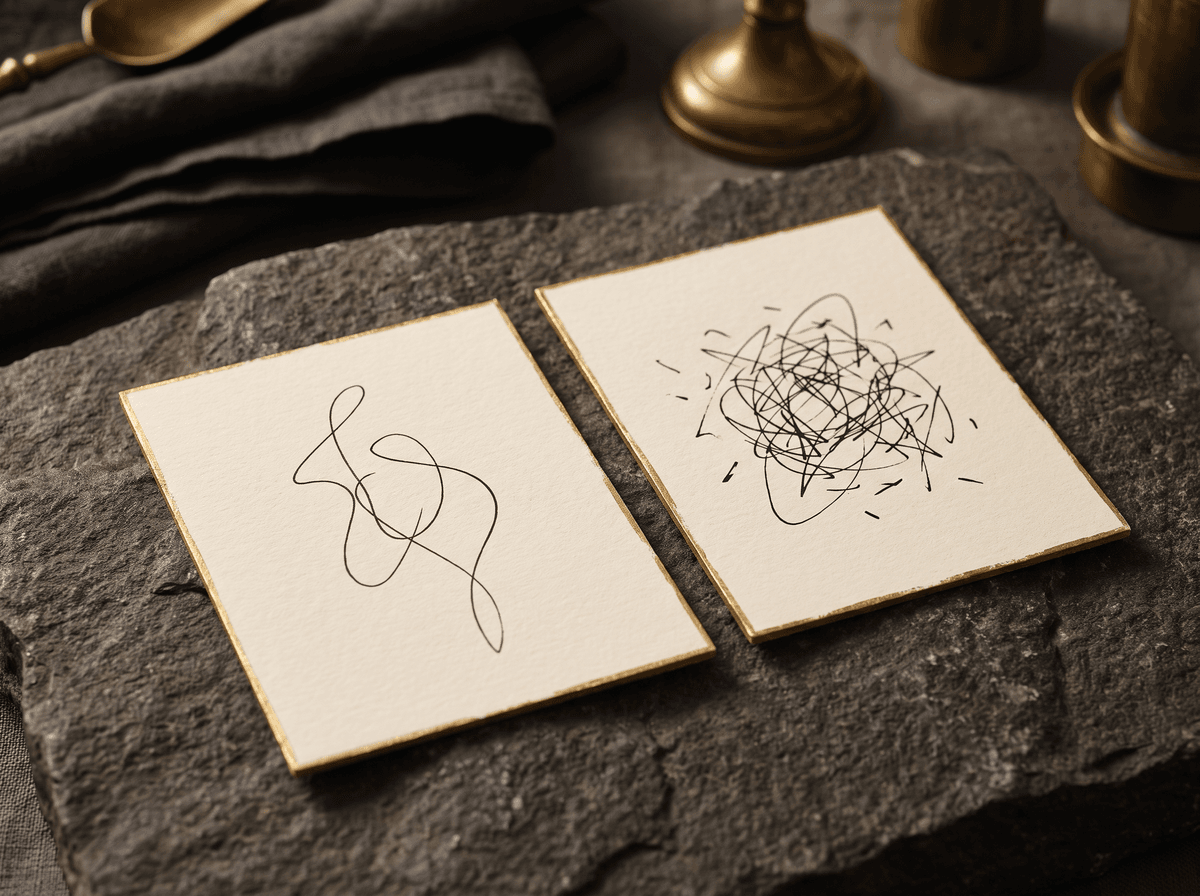
The question isn't resemblance; it's whether the same movement could have written it.
Comparison samples: no examination without them
Almost nothing can be established from one signature on its own. The examiner needs genuine samples known to come from the person, and the quality of those samples matters as much as the disputed signature itself.
- The more, the better. One or two samples don't show the range of variation. Examiners usually ask for considerably more.
- From the same period. Signatures change over the years, so samples close in time to the disputed signature are the most valuable.
- From similar situations. We sign a contract differently from a delivery terminal. Samples made in similar circumstances compare better.
- Natural and requested samples. Alongside signatures written unselfconsciously in everyday life (old contracts, applications), the examiner may ask for samples written in their presence.
- Originals where possible. On a photocopy or an image, pressure, nib marks and many fine details are lost.
Line quality: speed and fluency
One of the most telling signs is the line itself. People write their genuine signature quickly, without thinking, because the movement is practised. Someone imitating another person's signature usually works slowly, because they have to watch the shape. And slow and fast lines look different.
- Smooth, even curves
- Tapered starts and ends, because the pen meets and leaves the paper in motion
- Natural pressure changes between up and down strokes
- Fluent connections between letters
- Uneven, wavering or angular curves
- Blunt, rounded or dot-like starts and ends
- Flat, uniform pressure throughout
- Hesitations at the connections

No single sign proves anything. A slowly written signature can be genuine, for example if someone signed standing up, with a poor pen or in a very small space. That's why the examiner always looks at the signs together and at how they relate to the samples.
Tremor and hesitation: not every tremor is suspicious
A shaky line is one of the best-known signs, but also one of the easiest to misread. Two kinds of tremor need to be told apart.
- Tremor from slow imitation. When someone carefully follows an unfamiliar shape, the line wavers in tiny ripples, especially in complex curves and at connections. This tremor often appears exactly where the form is difficult.
- The hand's natural tremor. Age, illness, medication, cold, tiredness or an awkward position can make a genuine signature shaky too. Then the tremor is typically present throughout the writing, even in the easy parts, and shows up in genuine samples written in similar circumstances.
- Hesitation. A line that stops at a point and starts again, sometimes with a small ink blob or thickening. It may suggest the writer was checking a model, but it can also be a momentary distraction.
That's why samples should come from a similar stage of the person's life. An elderly person's signature written in hospital shouldn't be compared with their confident signatures from twenty years earlier, but with ones written in the same period.
Pen lifts, patching and corrections
Everyone has a habitual rhythm of where they lift the pen. Some people write their whole name in one stroke; others always pause after the capital. These habits are so automatic that the writer isn't aware of them.
- A pen lift in an unusual place. If a part is always written in one stroke in the genuine signatures but the line breaks there in the disputed one, the difference deserves attention.
- Patching. Lines added afterwards to repair a form that went wrong.
- Retracing. Strokes gone over twice, which are clearly visible under magnification.
- Stroke order. In some cases it's possible to tell which stroke reached the paper first, and that may differ from the usual order in genuine signatures.
Pressure and line width
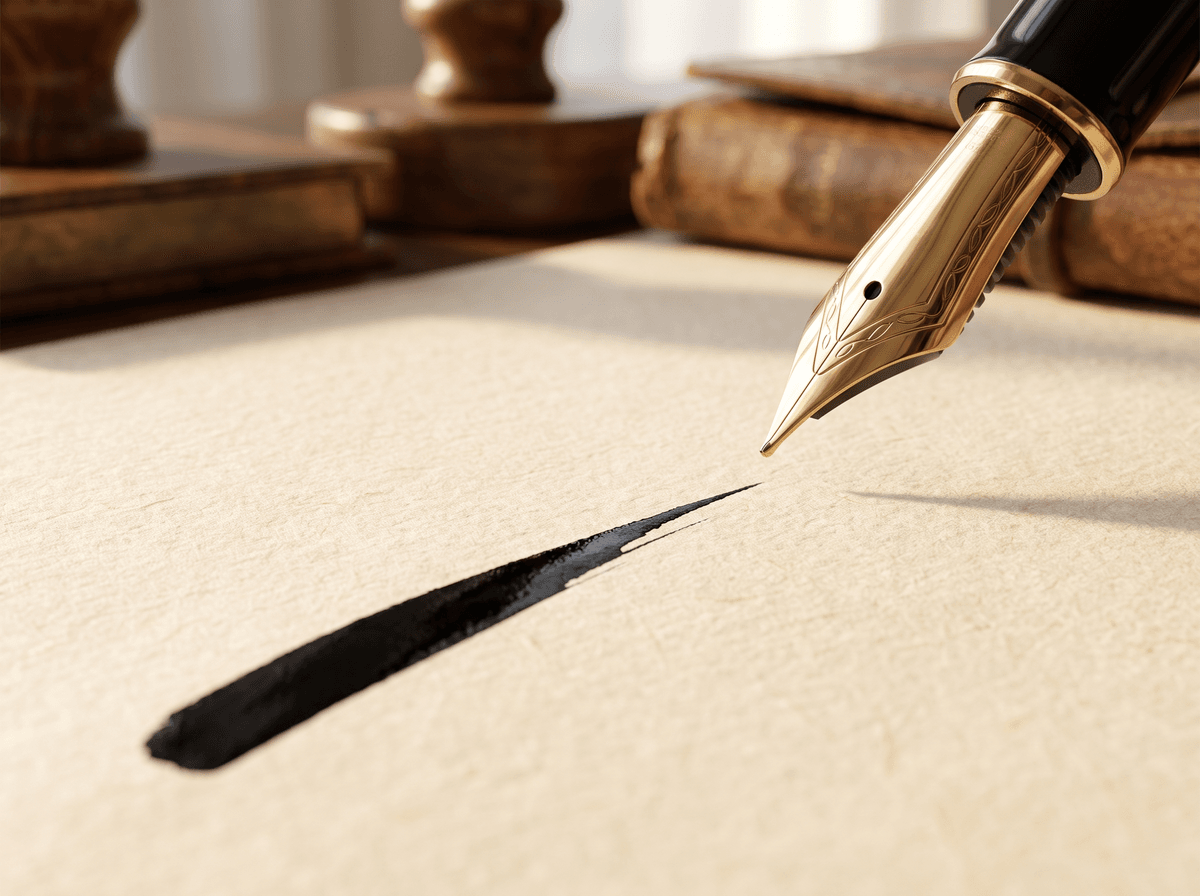
Pressure changes constantly as you write: usually heavier on downstrokes, lighter on upstrokes. This rhythm is characteristic of each person and often harder to imitate than the shape, because on paper it shows only subtly, in the width of the line and the groove pressed into the page.
- The habitual pressure pattern. The examiner checks whether pressure rises and falls in the same places as in the genuine samples.
- Uniform pressure throughout. A line drawn slowly and carefully often has even, flat pressure.
- Indentations in the paper. Heavy pressure leaves a groove and sometimes marks the sheet underneath. That can be an important source of evidence.
Proportions, slant and baseline: the hidden habits
An imitator usually focuses on the conspicuous shapes: the loop of the capital, the curve of the ending. But a hand carries many small habits nobody pays conscious attention to, and together they're highly characteristic.
- Proportions. How big the capital is compared with the small letters, how long the ending is relative to the name.
- Slant. How much the writing leans, and how consistently.
- Baseline. Whether the signature runs straight, rises or waves, and where it sits relative to the line.
- Spacing. The distances between letters, names and parts.
- Start and end points. Where the pen begins, where the first stroke comes from, which way the last one runs out.
- Small details. The position and shape of an accent or an i-dot, the direction of a connecting stroke.
A single match or difference says little on its own. What counts is what many independent features show together. We describe how a signature is built, from capital to ending, in the anatomy of a signature.
What tools do they use?
The examination rests on careful observation, but examiners use a range of tools to see details that stay hidden to the naked eye.
- Magnification and microscopes. The edges of the line, hesitations, retracing and stroke order become visible under magnification.
- Oblique light. Lit from the side at a low angle, grooves and indentations pressed into the paper stand out.
- Different light sources. Under certain lighting, different inks can behave differently, revealing whether more than one pen was used on a document.
- Indentation detection. Special methods can bring out invisible indentations on a sheet, such as writing made on a page lying on top of it.
- Overlaying images. When signatures are overlaid digitally, a suspiciously exact match between two of them stands out.
What can an examiner conclude?
A document examiner's opinion rarely comes down to a simple yes or no. Examiners usually express it on a scale of certainty: how likely it is that the disputed signature was, or was not, written by the person in question. If the conditions for examination aren't met, they may also state that no well-founded conclusion can be drawn.
- Few or poor samples. Without enough samples from the same period and similar situations, the conclusion will be more cautious.
- Only a copy. On a photocopy or image many details are lost, so the examination is more limited.
- A very simple signature. A short mark has fewer features to compare.
- The decision isn't the examiner's. In a court case, the examiner gives an opinion; the court decides, weighing it with the other evidence.
What this means for you day to day
Most people never find themselves in a situation where their signature has to be examined. If you do, a few everyday habits can help a lot.
- Sign consistently. If your formal signature is always similar, your genuine samples show your range clearly, and a different hand is easier to tell apart.
- Keep originals. Original copies of contracts and applications you've signed can later be valuable comparison samples.
- Never sign a blank sheet. And don't leave blank fields in a document you sign. See our pre-signing checklist.
- Look after your signature image. An examiner can often spot a digitally pasted signature, but it's better not to give anyone the chance.
- If you suspect forgery, get professional help. If you think someone has forged your signature, contact a lawyer or the authorities; they know how to request an expert examination formally.
The one sentence worth taking away
A document examiner doesn't ask how much a signature resembles the real one, but whether its speed, tremor, pen lifts, pressure and proportions fit the natural variation shown by many original samples from the same period, and states their opinion on a scale of certainty.
Questions
How can you tell if a signature is forged?
A document examiner compares the disputed signature with many genuine samples. They look at the speed and fluency of the line, tremor and hesitations, where the pen was lifted, pressure, proportions, slant and small habits. No single sign proves anything; what counts is the signs taken together.
Does a graphologist or a document examiner check forged signatures?
A document examiner. Graphology tries to read character from handwriting, while a document examiner carries out a technical comparison of movements, proportions and traces to establish whether writing could have come from a particular person.
How many comparison samples are needed?
There's no single number, but more is better, because one or two samples don't show the range of variation. The most valuable are original samples written close in time to the disputed signature and in similar situations. The examiner will say how many and what kind they need.
Can a shaky signature be genuine?
Yes. Age, illness, medication, cold or an awkward position can make a genuine signature shaky. That's why the examiner looks at the nature of the tremor and compares the disputed signature with samples from the same period.
Can forgery be detected from a photocopy?
Only to a limited extent. A copy or image loses pressure, the groove in the paper and many fine details, so the examiner will be more cautious or may state that no well-founded conclusion can be drawn. Where possible, the original document should be examined.
Try it with your own name
Read these too
Knowledge Law & official
Signing as a witness: what it means and what to watch for
A friend's power of attorney, a car sale, a will or a wedding: being asked to witness a signature is common. Here's what your signature confirms, what it doesn't, what to write next to it, and when it's better to say no.
 Law & official
Signing your ID card and passport: what to know
How your signature gets onto your documents, how to prepare before you sign a tiny pad or box, what to do if it goes wrong, and what happens if your signature changes later.
Law & officialBefore you sign anything: a contract checklist
Details, amounts, deadlines, blank fields, page numbers, attachments and copies: a practical checklist you can work through calmly before signing a tenancy, employment or service contract.