Knowledge › For teens
For teens
Signature ideas for long names: what to shorten and what to keep
If your name barely fits on one line, your signature can easily turn slow and cramped. Here's the order to shorten things in, what to always keep, and six long names worked through from start to finish.
“Alexandra Fitzgerald-Whitmore” or “Christopher Montgomery” sound lovely, but signing them is tiring. Write every letter and your signature turns slow, won't fit in boxes, and usually falls apart at the end, because your hand is tired by the time it gets there. With a long name the question isn't whether to shorten it, but what to shorten and in which order: keep the beginning, let the end go. In this guide we show the order of shortening, what's always worth keeping, five proven patterns, ways to compress without cutting, and six long names worked through into fast, recognisable signatures. If you're designing your first signature, our step-by-step guide to creating your own signature covers the basics.
When does a name count as long?
There's no exact cut-off, but for signing, a name is long if, written out, it doesn't sit comfortably on a standard signature line, or if writing it takes long enough that your hand slows down by the end. There are three typical cases:
- A long surname. “Montgomery”, “Fitzpatrick”, “Wolstenholme”: one name alone fills the line.
- A long first name. “Christopher”, “Alexandra”, “Maximilian”, “Anastasia”: the first name is a whole signature in itself.
- Lots of names together. A middle name, a double-barrelled surname, or both. Here no single name is long; the total is.
A good rule of thumb: if writing your full name slowly and carefully takes more than a few seconds, or it won't fit legibly into a 4 × 1 cm box, it's worth shortening. We've covered double-barrelled surnames and middle names in a signature in their own articles.
The order of shortening: drop this first
Shortening isn't random cutting. There's an order that works for most names: always let go of whatever adds least to recognition first.
- 1Middle name → initial. “Anna Mary Clarke” becomes “Anna M. Clarke”, or the middle name disappears. Middle names rarely play a part in everyday identification.
- 2Second surname → initial. “Dominika Fitzgerald-Whitmore” becomes “D. Fitzgerald-W.”: choose one main surname and let the other accompany it.
- 3First name → initial. If it's still long, the first name can become a single capital: “C. Montgomery”.
- 4End of the surname → wave. The first two to four letters of the surname stay readable, the rest becomes an even wave: “Montg” and a sweep.
- 5Last resort: monogram and a stroke. Just two initials and a tail. Fine for initialling pages, but rarely worth it as a main signature even with a long name. Short signature forms are covered in a separate article.
Stop at the step where your signature is already quick and fits. For most long names that's the second or third step.
What to always keep
However much you shorten, without a few elements the signature stops being your name and becomes just a line. These are worth keeping:
- The main capital. Your most important capital should be clean and recognisable. With a long name it's the anchor everything else follows. We have a detailed article on the capital.
- The first two to four letters. The eye reads the beginning of a name. If “Montg” is readable, “omery” can be a wave and people will still know who signed.
- The name's distinctive letter. A tall “k”, a deep “y”, a double “tt”: if there's a striking shape in the middle of your name, hint at it in the wave, because that's what makes it yours.
- A sense of length. The shortened part should still have roughly as many waves as the syllables it replaces. A long name shouldn't shrink to a single dot.
- The hyphen, if your name has one. A short, firm stroke is enough, but it's worth showing because it's part of the name.
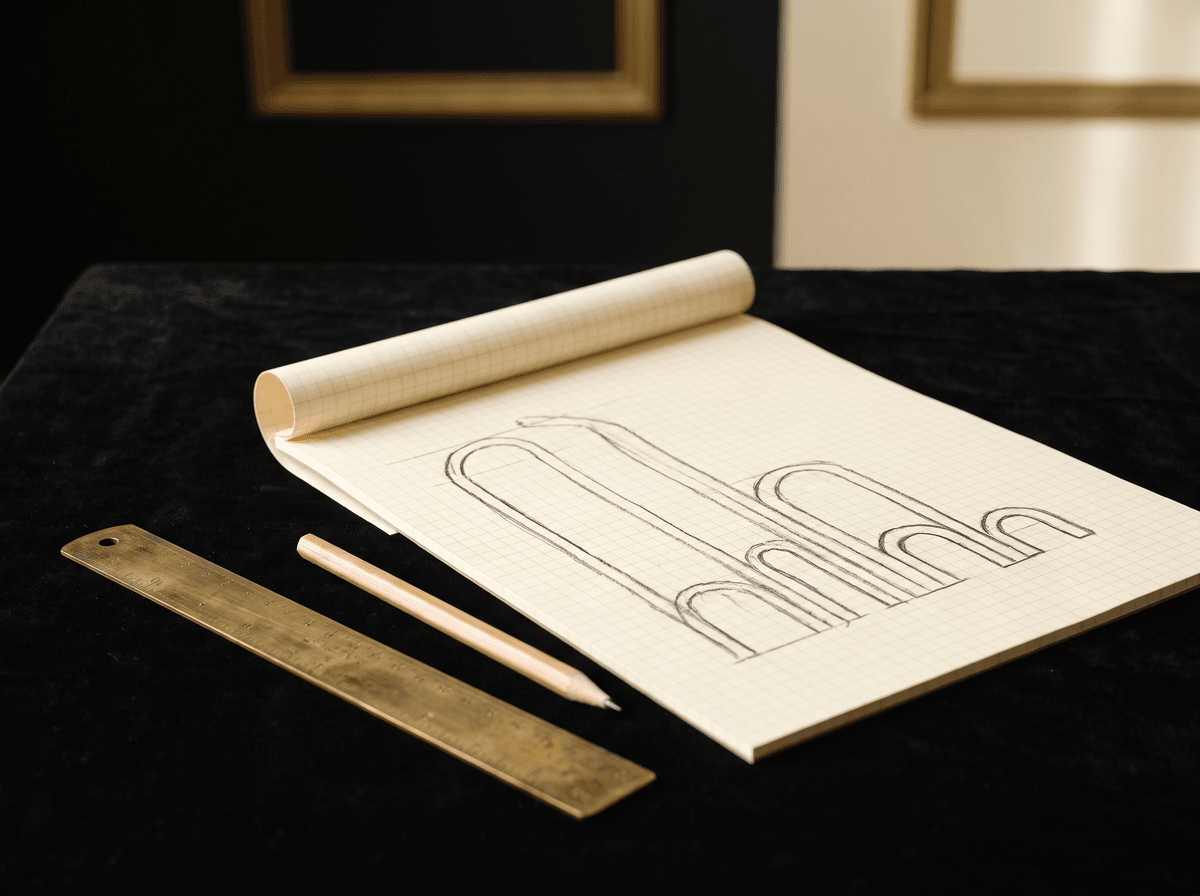
Five proven patterns for long names
Most good long-name signatures follow one of these five patterns. We'll show each with “Alexandra Montgomery”.
- 1. Initial plus full surname. “A. Montgomery”: formal, readable, and initialling the first name saves a lot. A safe choice for a first signature.
- 2. Full first name plus surname initial. “Alexandra M.”: if your first name is what everyone knows you by. Good for everyday use; whether it's enough somewhere official is up to the institution.
- 3. Readable start, flowing end. “A. Montg” clearly, “omery” as an even wave. The most common adult signature: the start says who you are, the end sets the pace.
- 4. Two strong capitals and a sweep. A big “A” and a big “M”, with a flowing line between and after them. Quick and modern, but less readable.
- 5. Surname first, then initial. “Montgomery A.”: the order used on many forms and lists. Useful if you often sign next to your printed surname.
Compression tricks: shorter without cutting
Before you drop any letters, try writing the same name in less space. These techniques make even a full name shorter:
- Lower x-height. Reducing the height of the lowercase letters is the most effective trick: the capital stays, the small letters shrink, and the name gets shorter but stays readable.
- Tighter spacing. Letters move closer together without touching. A tall, narrow style works especially well for long names.
- Fewer loops. An “l” or “k” without a loop, as a single straight stem, takes half the space and time.
- Merged letters. Two letters in one movement: “tt” with a shared crossbar, “ll” as two matching stems, “th” as one connected shape.
- Dots and crossbars together. Dot the i's and cross the t's in a single stroke at the end, or leave them out. Our article on accents and dots goes into detail.
- Fewer pen lifts. Every lift costs time. Join first name and surname with a curve if it feels natural to your hand.

Worked examples for six long names
For each name we suggest one direction and one alternative. They're starting points; the letter shapes should always come from your own hand.
- Christopher Montgomery. Suggested: “C. Montg” readably, “omery” as a wave, the “y” closing with a short tail. Alternative: “Chris M.” for everyday use, if that's what everyone calls you.
- Dominika Fitzgerald-Whitmore. Suggested: “D. Fitzgerald-W.”, the hyphen as a short, firm stroke. Alternative: a big “F” and a big “W” with a wave between, the first name dropped to an initial in front.
- Bartholomew Ashworth. Suggested: “B. Ashworth” in tall, narrow letters, the “th” merged into one shape. Alternative: “Bartholomew A.” if you sign mostly informal things, with “tholomew” as a wave.
- Anastasia Wolstenholme. Suggested: “A. Wolsten” readably, “holme” as a wave with a tall “l” left visible. Alternative: two capitals, “A” and “W”, with a sweep, if you usually sign in small spaces.
- Maximilian Kowalczyk. Suggested: “M. Kowal”, the “K” as the main accent, “czyk” as a wave with the deep “y” loop returning as an underline. Alternative: “Max Kowalczyk” if “Max” is the name you use.
- Elizabeth Featherstonehaugh. Suggested: “E. Feather” readably, the rest as a wave. Alternative: “Elizabeth F.”, with one strong “E” and an initial, for everyday use.
In small spaces: a second, even shorter form
With a long name it often helps to have a main signature and a shorter relative for tiny boxes, like the back of a bank card or a cramped field on a form. What matters is that both start with the same capital and slant, so they look like members of one family.
- Main signature. “A. Montgomery” on a standard signature line.
- For small boxes. “A. Montg” and a short wave.
- For initialling. An “AM” monogram with a short stroke.
If the box is really tiny, our article on signing in small spaces has more tricks.
The finish on a long name: less is more
With short names the finish adds length. With long names it's the opposite: the name already fills the line, so a short, tapering tail is usually better than a long underline. A full-length underline under a long name slows you down twice and is bound to overflow a small box.
- A short tail. The best default. Quick, and it takes no extra room.
- An underline under part of the name only. If you want an underline, run it under the main name, not the whole signature.
- No finish at all. With a long name it's perfectly fine for the name simply to end.
Types and proportions of signature finishes are covered in a separate article.
Common mistakes with long names
- Writing every letter, every time. The full name is lovely, but if it's slow and the end falls apart every time, it isn't consistent. Better a deliberate shortening than a rushed, smudged ending.
- Shortening the wrong part. If you drop the beginning and write out the end, no one will recognise it. The start of the name matters most.
- Shortening too much. A long name turned into a dot and a line: quick, but nothing about it points to you any more.
- Two equally strong capitals. In “Fitzgerald-Whitmore”, the “F” and the “W” compete. Pick one as the face; keep the other simpler.
- Long flourishes. A long underline and big loops on top of an already long name overflow every box.
Testing: fast, fits, recognisable
- 1The time test. Write it five times at your normal pace. Is it done in a few seconds? If not, go one step further in the shortening order.
- 2The box test. Draw a 4 × 1 cm rectangle and sign inside it. Does it fit, with a readable capital?
- 3The fifth-signature test. Does the end of your fifth quick signature look like the end of the first? If the ending falls apart, shorten there.
- 4The fresh-eyes test. Show it to someone who knows your name. Can they tell it's yours?
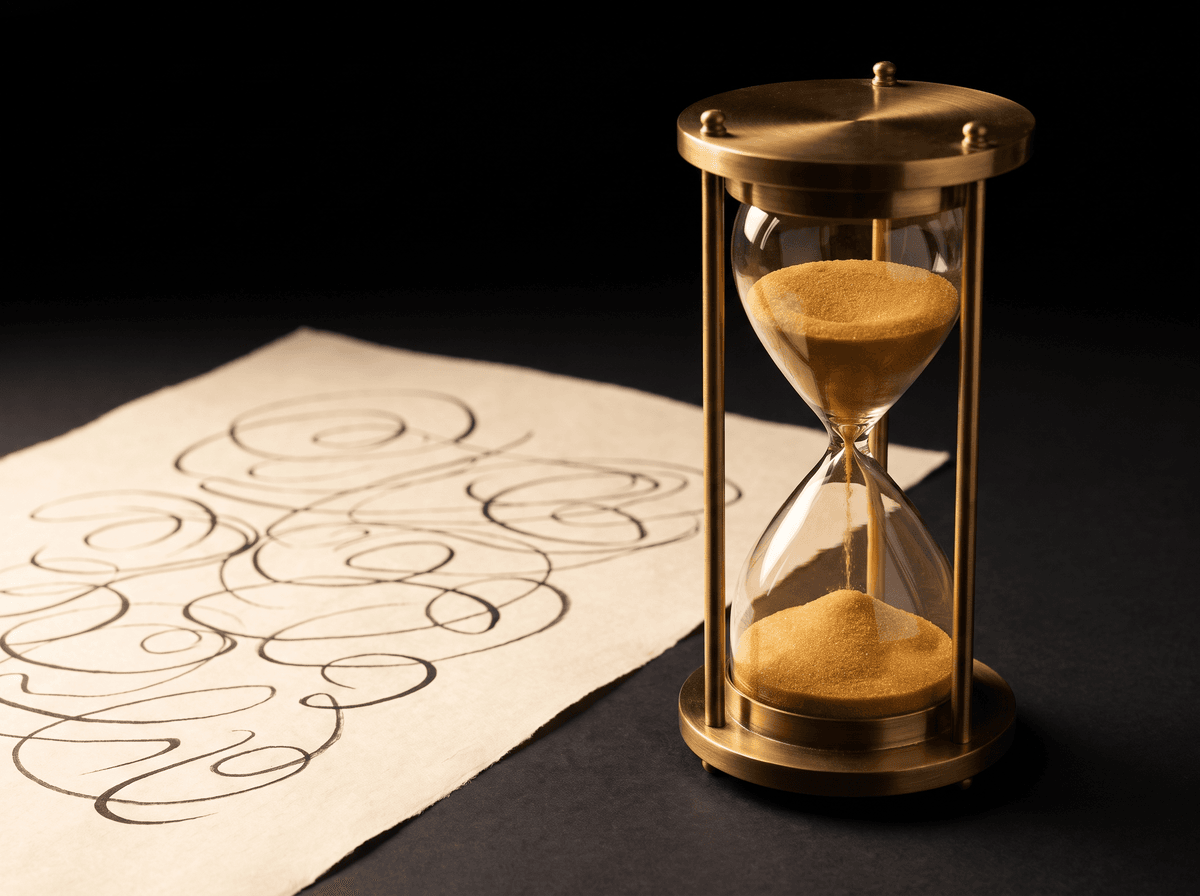
If it passes all of them, it's time to practise. Ten minutes a day for a week and the shortened form comes naturally; our practice guide explains how.
Long names in Calligra
Calligra creates several different signatures from your full name, and with a long name you don't have to decide in advance what to shorten: try the full name, initial versions or just your main name, and see side by side which is quickest and most readable. You can then learn your chosen design stroke by stroke, with animation.
Try it with your name and see how fast and unified a signature from a long name can be.
The one sentence worth taking away
With a long name, keep the beginning and let the end go: shorten the middle name and second surname to initials first, keep the main capital and the first two to four letters readable, let the rest become a wave, and finish with a short tail.
Questions
How do I sign my name if it's very long?
Keep the main capital and the first two to four letters of your surname readable, and shorten the rest to a wave or initials. Shorten the middle name and any second surname first, and stop where the signature is quick and fits.
Should I shorten my first name or my surname?
Usually the first name goes to an initial and the start of the surname stays readable, since that's what official places look for. If your first name is what everyone knows you by, the reverse can work; what a particular institution accepts can vary.
Does every letter need to show in a long-name signature?
No. In many adult signatures only the start of the name is readable and the rest is an even wave. What matters is that you write it the same way every time and the capital is recognisable.
How do I sign a double-barrelled name?
Pick one main name to write out, shorten the other to an initial, and show the hyphen with a short stroke. There are more examples in our article on double-barrelled surnames.
Should a long name have an underline?
It isn't necessary, and often it hurts. A long name already fills the line, so a short, tapering tail is quicker and fits better. If you want an underline, keep it under the main name only.
Try it with your own name
Read these too
Knowledge Cultures
Non-Latin name: sign in Latin letters or your own script?
Grew up writing your name in Cyrillic, Chinese, Japanese, Korean or Arabic, and now you're signing papers in a Latin-script country? When each script works better, whether you can use both, and how to design a Latin-letter signature when it isn't the script you learned to write in.
 For teens
Autograph vs signature: what's the difference, and which should you practise?
A signature identifies you; an autograph is a keepsake. Here's how the two differ, which one to practise first, and how to design an autograph that looks great without giving away your official signature.
 Basics
Cursive vs print signature: pros, cons, and which one suits you
Plenty of people print rather than write joined-up these days, and wonder whether they can sign that way. They can. Here's what cursive does better, what print does better, the semi-cursive middle ground, and how to turn a printed name into a real signature.