Knowledge › Name change
Name change
The Hungarian “-né” married name and your signature: what to write if you became Kovácsné
Kovács Jánosné, Kovács Jánosné Nagy Éva or Kovácsné Nagy Éva: “-né” names are longer, have a different rhythm and end with an accent. Here's what to put in your signature, what you can shorten, and how to make it one quick, consistent movement.
The “-né” form is a peculiarity of Hungarian naming: few languages have a married name that attaches a suffix to the spouse's name. If you choose it, your signature gets a different job. The name becomes longer, a new capital may move to the front, and the “né” ends with an accent that easily shrinks to a dot when you hurry. A good “-né” signature doesn't spell out the whole legal name letter by letter; it picks one leading part, shortens the rest and turns the “né” suffix into a flowing continuation. In this article we go through what each “-né” form means and give two or three signature versions for each. We don't give legal advice on choosing a name: which forms you can choose from is set by law and explained by the registrar.
What makes a “-né” name different in a signature?
The “-né” suffix shows that the name comes from marriage. For a signature, three things change, and it's worth thinking about each in advance.
- It gets longer. “Kovács Jánosné Nagy Éva” is four words, almost twice as many letters as “Nagy Éva”. Write it all out and the signature becomes slow and won't fit small boxes.
- A new capital may lead. If you used to start with “N” and now “K” comes first, the face of your signature changes. That needs separate practice.
- It ends with an accent. The accent on “né” sits at the end of the word, just where your hand is preparing to finish. In a hurry it easily disappears or becomes a dot.
The good news is that none of this is hard to solve, and a lot can be carried over from your old signature. What to keep from your old form is covered in a new signature after marriage; here we focus on what's special about “-né” names.

First check: exactly which form is yours?
Before you design a signature, take out your new ID or marriage certificate and check exactly how your name is written. In the examples, Nagy Éva marries Kovács János (Hungarian puts the surname first). The “-né” forms look roughly like this:
- Kovács Jánosné. The husband's full name with the “-né” suffix. The wife's own name doesn't appear. The shortest “-né” form, but the signature carries the husband's first name.
- Kovács Jánosné Nagy Éva. The husband's full name with “-né”, followed by the wife's full own name. The longest form, with four words.
- Kovácsné Nagy Éva. The husband's surname with “-né”, followed by the wife's full own name. Many choose this because it keeps both her first name and her birth surname.
Options without “-né”, such as “Kovács Éva”, keeping “Nagy Éva” or the double “Kovács-Nagy Éva”, set a different signature task. Signing a double surname has its own article.
Does the signature need the full name?
This is the most common question, and the answer is usually no. A signature isn't your name written out; it's a mark that's yours and that you write the same way every time. On your documents your name is printed anyway, with the signature beside it. In many adult signatures part of the name is legible and the rest shortens into a wave.
What does matter is that the signature can be connected to your name. If your legal name is “Kovács Jánosné Nagy Éva” and your signature starts with a “K”, that's natural. If it starts with an entirely different letter, it may look odd to anyone comparing the two. How much of your name a signature needs is covered in more depth in how legible your signature should be.
A signature doesn't have to say your whole name, only that it's you.
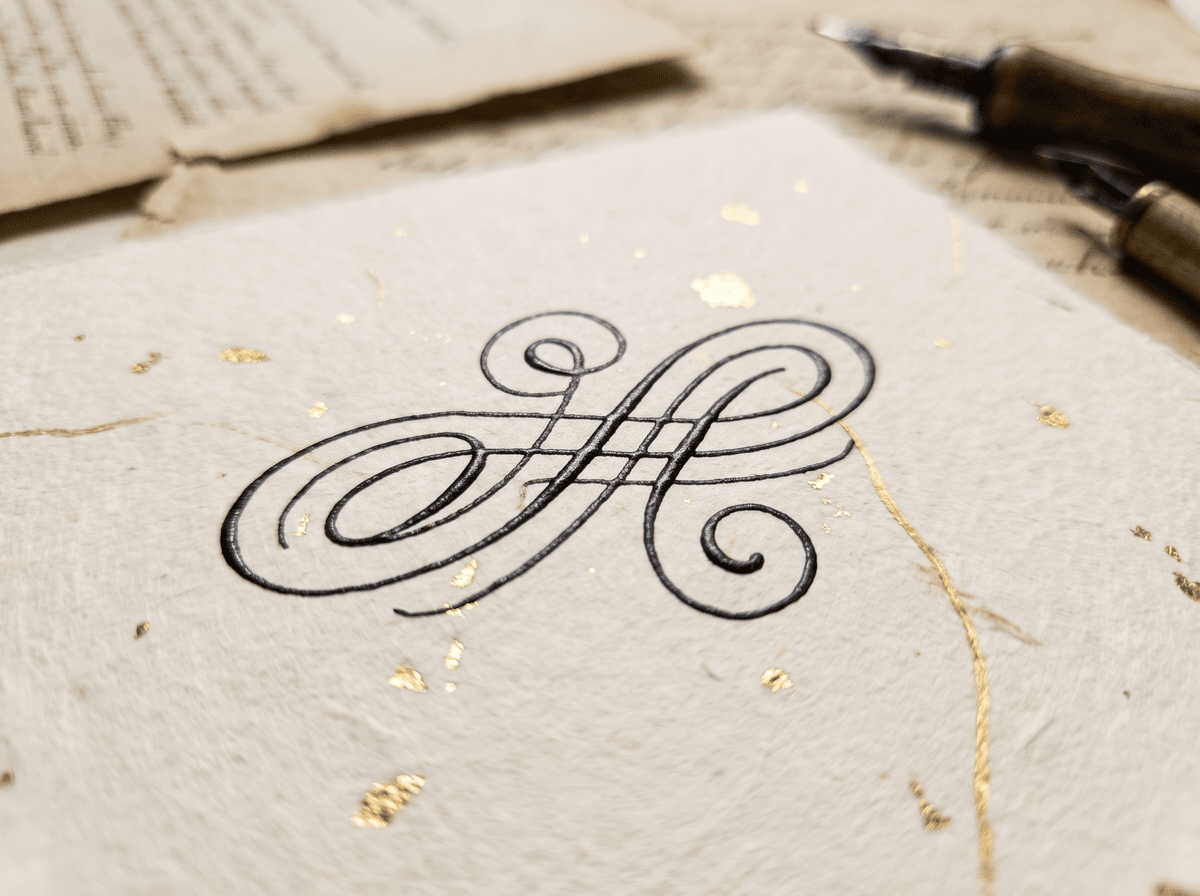
“Kovács Jánosné”: signing with the husband's full name
This form is short, but many find it unfamiliar because their husband's first name appears in place of their own. If this is your choice, it's worth finding a version you enjoy writing and that feels like yours.
- Written out: “Kovács Jánosné”. Two words, easy to read. The “K” leads and “Jánosné” can run out into an even wave. The clearest choice for official papers.
- Abbreviated: “Kovács J.-né”. A long-established abbreviation in everyday Hungarian writing. Quicker, and the “J.-né” part reduces to a small mark: a “J”, a dot, a short hyphen and “né”.
- The surname leads: “Kovács” and a trailing stroke. “Kovács” is legible and the suffix shortens into a flowing line. Quick, but it hints less at the “-né” form; if you want that to show, choose one of the first two.
With this form, many people feel their own name has disappeared. If that bothers you, keep your hand's characteristics in the signature: the slant, the ending, the style of the capital. The name is different, but the signature stays recognisably your handwriting.
“Kovács Jánosné Nagy Éva”: the longest form
Four words, three capitals and a suffix. Write everything out and it barely fits on a normal signature line; in a hurry the start is tidy and the end falls apart. The key decision here is which part leads.
- The “-né” part leads. “Kovács J.-né N. Éva”: “Kovács” is legible and the rest follows in short form. It shows the structure of the legal name and still fits.
- Your own name leads. “K. J.-né Nagy Éva”: a short, initial-based “-né” part at the start, then your own name legibly. Many choose this because the familiar “Nagy Éva” movement stays.
- One capital, one wave. A strong “K”, then a rhythmic wave, with a small “é” mark at the end. The quickest, ideal for small spaces, but less legible on official papers.
If you liked your old signature, the second version is the easiest: you can take over the “Nagy Éva” part almost unchanged and only learn the beginning. If you want a fresh start, the first or third suits better.

“Kovácsné Nagy Éva”: the most popular choice
Three words, all familiar: the spouse's surname with the suffix, your birth surname and your first name. For many this is the easiest “-né” signature, because “Kovácsné” is a single word you can write in one sweep.
- Written out. “Kovácsné Nagy Éva”: legible but long. Good if you sign a lot of official papers and have the room.
- “Kovácsné” leads, the rest shortens. “Kovácsné N. Éva”: “Kovácsné” is one joined word and “Nagy” becomes a single “N”. Quick, tidy, and the structure of the legal name still shows.
- Your own name leads. “K.-né Nagy Éva”: the beginning is a short mark and “Nagy Éva” stays legible. If your old signature was built on “Nagy”, this is the easiest to learn.
The technique of “né”: the join, the dot, the accent
“Né” is only two letters, yet it decides whether the end of the signature looks tidy or rushed. A few small decisions make a big difference.
- Join it, don't tack it on. In “Kovácsné” the end of the “s” can run straight into the start of the “n”. Don't lift the pen before “né”, or the suffix looks like a separate piece.
- When abbreviating: dot and hyphen. “J.-né” needs a dot and a hyphen. The dot can be tiny; the hyphen a short, firm horizontal stroke. It shouldn't be longer than the “né” itself.
- Make the accent your finish. Many people place the accent on “é” at the very end, as a short upward stroke. That doubles as the ending: the pen finishes on the paper and lifts off from there.
- Always the same. Whether the accent is a long stroke or a tiny dot, make it identical every time. Handling accents in a signature is covered in a separate article.
Two or three capitals: choose one face
“Kovács Jánosné Nagy Éva” contains several capitals: “K”, “J”, “N” and “É”. If each is equally large and ornate, the eye doesn't know where to look and the signature feels restless.
- 1Choose one main capital. This is the tallest, and it can carry a loop or a distinctive curve. Usually it's the “K”, because it comes first.
- 2Keep the others simpler. The second and third capitals are smaller, with fewer strokes. Recognisable is enough.
- 3Keep the same slant. If the main capital leans right, the others should lean the same way. That's what holds a long name together.
Designing a capital, including the easy and tricky Hungarian ones, is covered in our detailed article on designing the capital. If the “K” or another new capital won't settle in your hand, write it thirty times on its own before trying the whole name.
Official papers and everyday life
With a long “-né” name, many people ask whether they can have two versions: a fuller one for official papers and a shorter one for parcels or a tiny box. That's a common solution, as long as it's consistent.
- New ID, passport, bank
- Contracts and official forms
- A legible leading part, such as “Kovácsné”
- The abbreviations are always the same
- This is the specimen you give
- Parcels, card terminals, small boxes
- Internal papers, sign-in sheets
- Same capital and slant
- The rest shortens into a wave
- Don't let it multiply into a third and fourth
The short version should come from the official signature, with the same capital and ending, so the two clearly belong together. Short signature forms and having more than one signature are covered in their own articles.
Practising and rolling it out
A “-né” signature really becomes yours when you no longer have to think about the suffix. A few weeks of short, regular practice is enough, ideally before your new documents.
- 1First days: the parts separately. The main capital on its own, then the “né” join with its accent. Slowly, large, one line each.
- 2Then: the whole name. Put the parts together and write the full signature ten times in a column. Notice where the pen hesitates.
- 3Speed and small spaces. Speed up gradually and try it in a 4 × 1 cm rectangle. If it falls apart, shorten one more part.
- 4At your new documents: the final form. Go with the practised signature, because the specimen is recorded there. What comes next is set out in order in the name change checklist.

If you'd like to see your “-né” name in a few different styles, Calligra designs it for your name and teaches it letter by letter. Try it with your name.
If the name changes later
A “-né” form isn't necessarily permanent. Some people later switch to another form, or take back their birth name after a divorce. Which name changes are possible in which situation is something the registrar can explain.
For the signature it's the same situation as now: a new name goes with a new signature, best given in a consistent form on the new documents. If you return to your birth name, the article on signing after divorce helps you decide whether to bring back your old form or design a new one.
The one sentence worth taking away
With a “-né” signature, don't write everything out: choose one leading part and one main capital, shorten the rest the same way every time, join the “né” suffix, and make its accent part of the finish.
Questions
How should I sign my “-né” name?
Choose one leading part of the name, such as “Kovácsné” or your own name, and write that legibly. Shorten the rest, for example to “J.-né” or “N.”. Join the “né” suffix to the letter before it, and place the accent the same way every time.
Do I have to write the whole “-né” name in my signature?
Usually not. A signature is a mark, not the full name written out, and your name is printed on the document anyway. It does matter that the signature can be linked to your name and that you write it the same way every time. What a particular institution expects is up to them.
Can I sign as “Kovács J.-né”?
That's a long-established abbreviation of “Kovács Jánosné”, and many people sign that way. What matters is that you always write it like that and give the same form as your specimen on your documents and at the bank.
What should I do with the accent at the end of “né”?
Many people place it at the very end as a short upward stroke, so the accent doubles as the ending. A small dot works too. The key is that it looks the same every time and doesn't vanish when you hurry.
Can I keep part of my old signature?
Yes. If you chose “Kovácsné Nagy Éva” or “Kovács Jánosné Nagy Éva”, your own name part, such as “Nagy Éva”, can carry over almost unchanged, and you only need to learn the beginning.
Try it with your own name
Read these too
Knowledge Name change
Taking back your maiden name: a new signature after divorce
If you return to your birth name after a divorce, your signature changes too. There are two ways to go: bring back your old form, or design a completely new one. Here are both, calmly, step by step.
 Creative
Wedding invitations and thank-you cards: how to sign them as a couple
Who signs, in what order, with your old name or your new one, first names or full names? Here are the wordings that work, how to make two signatures look right side by side, and how to keep the fiftieth card as neat as the first.
 Law & official
Signing as a witness: what it means and what to watch for
A friend's power of attorney, a car sale, a will or a wedding: being asked to witness a signature is common. Here's what your signature confirms, what it doesn't, what to write next to it, and when it's better to say no.