Knowledge › For teens
For teens
Signature ideas for short names: making 3–4 letters look like a real signature
Amy, Ben, Leo, Eva, Max: a short name is quick to sign, but the signature can easily look thin. Seven proven techniques and lots of worked examples for giving a few letters weight and character.
If your name is short, your signature is done in the blink of an eye. That's a real advantage, and plenty of people with long names envy it. The trouble starts when you look at the page: an “Amy Cox” or a “Ben Fry” in the middle of a signature line can look small, awkward, unfinished, as if something were missing. With a short name, a good signature doesn't come from the number of letters but from how much movement and space those few letters get. In this guide we show seven techniques for making a 3–4 letter name feel fuller, with lots of worked name examples, plus what to avoid so it doesn't look forced. If you're designing your first signature, our step-by-step guide covers the basics; this article answers the questions specific to short names.
Why a short name can look thin
The eye sees a signature as one shape, not a row of letters. With a long name, that shape comes from its length: there's a beginning, a middle and an end. With three or four letters the length is missing, and if the letters are also short, round and similar, the shape collapses into a small blob.
- Few tall or deep letters. An “Ava” or an “Ian” is almost entirely x-height letters, with no ascenders or descenders to break it up.
- No time to build momentum. By the time the pen gets going, the name is over. That can make the signature look slow and cautious.
- Too much white space. A normal signature line is much longer than a short name, and the empty rest of it highlights how small the mark is.
The good news: each of these has a simple fix, and none of them involves adding made-up letters to your name.
First decision: write your full name
With long names, the first question is what to shorten. With short names it's the other way round: it's almost always worth writing your full name, first name and surname. An “Amy Cox” is still only six letters, but now it has two capitals, a gap and a rhythm.
- “Amy Cox” rather than “Amy”. The second name adds a second accent, and the line looks fuller.
- “Ben Fry” rather than “B. Fry”. Shortening a short name doesn't save time; it takes away content.
- If both names are short, this matters most. “Max Day”, “Zoe Lee”, “Tom Ray”: written in full they're still quick, yet they look like a complete signature.
Seven techniques to make a few letters show more
You don't need all seven. Two or three are usually enough for a short signature; use them all at once and the shape becomes overdecorated.
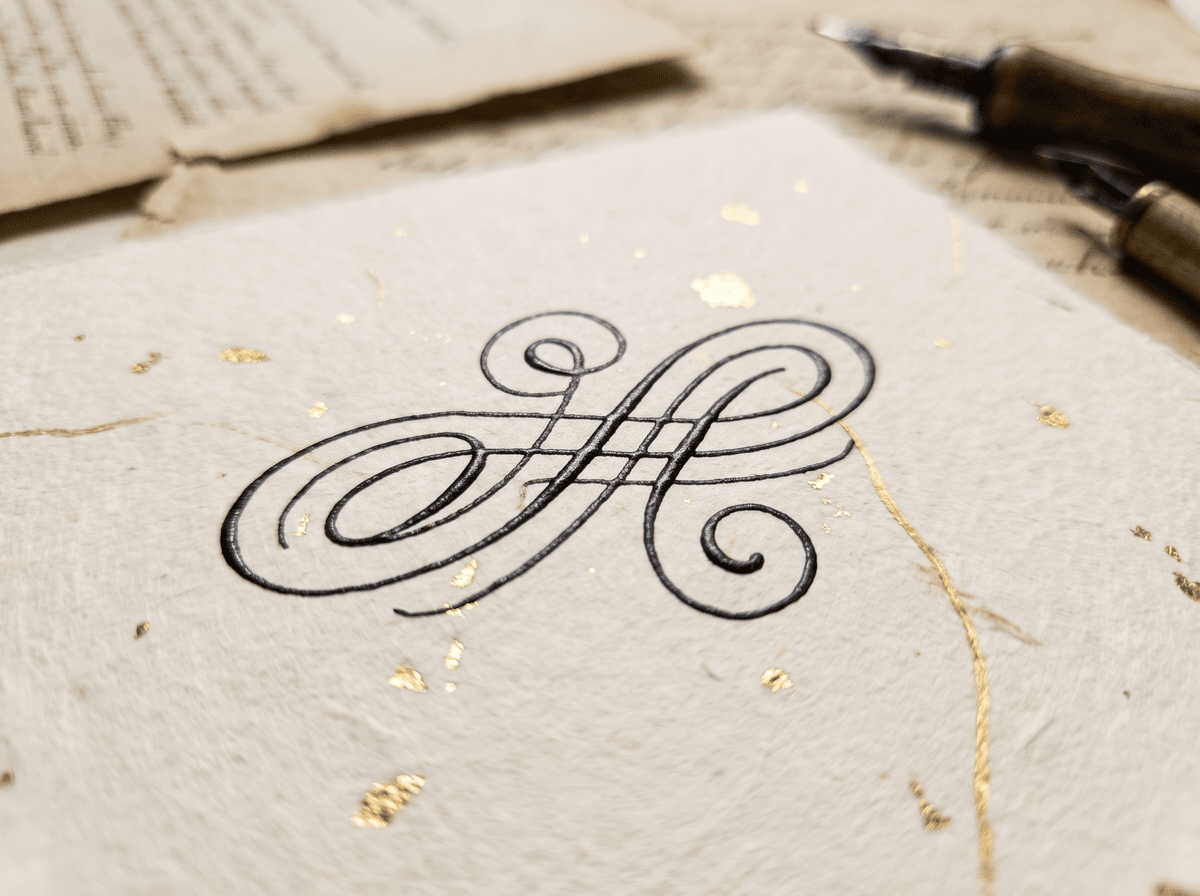
- 1A bigger, livelier capital. With a short name the capital can be two and a half or even three times the height of the lowercase letters. That gives the height that the length can't.
- 2A long entry stroke. Let the pen start before the letter, with a sweeping curve from below or from the left. The mark then begins before the name does.
- 3Wider, more open letters. Rounder, airier shapes fill more space. An “a” or “o” can be roomier, the spacing slightly wider.
- 4Make the most of ascenders and descenders. If your name has a tall letter (d, l, b, k, h) or a descending one (g, j, p, y), give it room: a tall “d” in “Ada” or a deep “y” in “Amy” breaks up the shape.
- 5Double letters as rhythm. “Anna”, “Emma”, “Otto”, “Bella”: two matching letters can become one lovely repeating wave.
- 6A finish that runs under the name. An underline, a return curve or a trailing tail makes the mark longer without adding a single letter.
- 7Accents and dots as decoration. “Zoë”, “Léa”, “Joé”: an accent, or even the dot of an “i” or “j”, can become a lively slanted stroke that's part of the signature, not a stray speck.
Worked examples: girls' names
For each name we show two or three directions. They're starting points, not templates; the shapes of your letters should always come from your own hand.
- Amy Cox. 1) A tall “A” with a long entry stroke, the “y” in “Amy” dropping into a deep loop that sweeps back under the whole name. 2) The “C” and the “x” as the two accents, with small, quick letters between them and a short tail.
- Eva Hart. 1) A big, two-curve “E”, the “va” running into a wide curve. 2) The cross of the “t” in “Hart” stretched over the whole surname, like a roof.
- Ada Lee. 1) The “d” gets a tall ascender whose loop starts the finish. 2) The “L” has a long foot that runs under “ee”, like a pedestal.
- Zoe Bell. 1) A “Z” with a loop in the middle and a long horizontal foot reaching under the name. 2) The double “l” in “Bell” as two tall columns, closed with a return underline.
- Emma Ray. 1) The “mm” as three or four even waves, the “y” of “Ray” dropping into a tail. 2) Two open capitals, small fast lowercase, and an underline that starts from the “y”.
- Mia Fox. 1) A tall, pointed “M”, the dot of the “i” merged into a slanted stroke. 2) The “x” in “Fox” finishing with a long rising stroke, like a tail.
Worked examples: boys' names
- Ben Fry. 1) The “B” with a long entry stroke, the “y” in “Fry” dropping into a loop that turns into an underline. 2) Sharp, angular “B” and “F”, round open lowercase between: crisp and youthful.
- Leo Day. 1) The foot of the “L” stretches far under “eo”, like a base. 2) Two plain capitals, full name rather than “L. Day”, and the “y” closing with a short rising tail.
- Max Hill. 1) A big, pointed “M”, the “x” crossing into a forward stroke. 2) The double “l” in “Hill” as two tall loops, the second one sweeping back as an underline.
- Tom Reid. 1) The cross of the “T” runs long and turns back under “om” as an underline. 2) The “d” of “Reid” gets a tall ascender and a forward tail.
- Sam Kay. 1) The “S” as one long, flowing curve, starting well before the name. 2) The kick of the “k” leading straight into “ay”: both names in one movement.
- Ian Lowe. 1) A tall, simple “I” with an entry stroke, the “L” as a strong second accent. 2) The “w” in “Lowe” as one quick zigzag ending in a rising tail.
When you only write a short first name: dedications and artwork
Sometimes only your first name goes on paper: in the corner of a drawing, on a card, in a dedication. Here three or four letters really can feel like too little, but the same tools work, just more boldly.
- One big capital the rest runs into. “Ada”: a huge “A” with a loop, the “da” sitting at its foot.
- A personal mark at the end. A star, a dot, a year or a small wave that's always there.
- A rounded shape. “Bea”, “Ali”, “Noa”: the name written into a circle or a wave, like a small logo.
These are really autographs rather than signatures. What the difference is, and why it's worth keeping the two apart, is covered in our article on autographs.
The finish: a short name's secret weapon
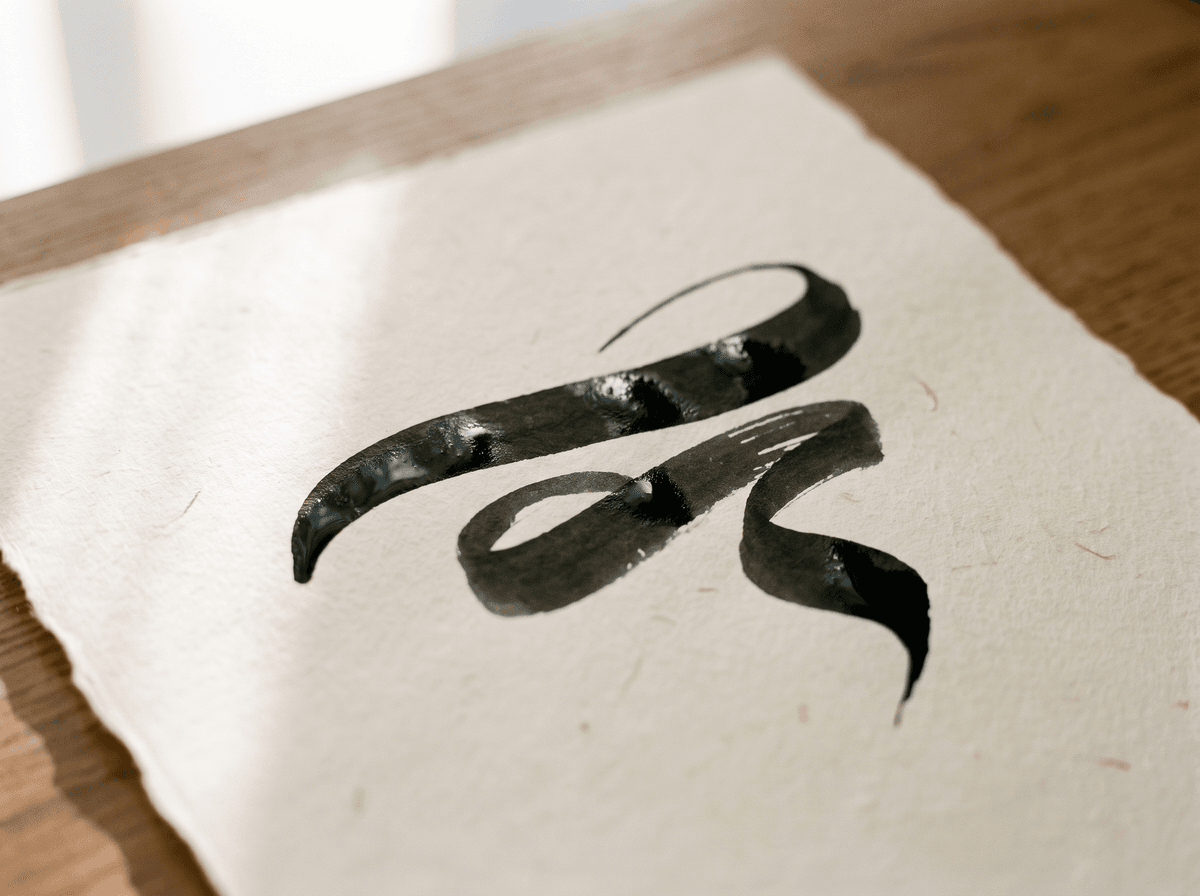
With a long name the finish is often just a short tail, because the name already fills the line. With a short name, the finish is one of the most important parts: it supplies the length the letters can't.
- Return underline. It starts from the last letter, turns back and runs left under the name. It fills the space below and frames the signature.
- A long, tapering tail. The end of the last letter trails off to the right, rising slightly. The simplest way to make a short name look longer.
- A loop under the name. The loop of a descender (g, j, y) sweeps back as an underline. Eye-catching, but only if the capital is simpler.
As a proportion, the finish on a short name can be as long as the name itself, but not much longer, or it drowns the name out. The types and proportions of finishes are covered in detail in a separate article.
What not to do
- Don't add made-up letters. An “Amyyy” or a meaningless row of loops adds confusion, not content. Your signature should be your name.
- Don't overdecorate. Three loops, two stars and a double underline on a four-letter name quickly turn into a caricature. One or two main features are enough.
- Don't write it too small. People with short names often sign tiny, because “it's over in a second anyway”. Short and small together look unsure.
- Don't abbreviate. A bare “A. C.” or a monogram saves almost nothing with a short name, but costs a lot of recognisability. Monograms are great for initialling; see our article on short forms.
- Don't slow down. Decoration mustn't take longer than the name itself. If your signature needs concentration, it will drift when you rush.
The upside of a short name: use it
Many people only see the downside, but for signing, a short name is mostly an advantage:
- It's fast. At a till, a card terminal or on an attendance sheet, a short name is done in a moment, and it doesn't fall apart when you rush.
- It fits small spaces. The back of a bank card, a tiny box on a form: where people with long names have to abbreviate, you can write your full name. We cover signing in small spaces separately.
- It's easy to keep consistent. Fewer letters, fewer places for errors. You'll be able to write a short signature the same way every time sooner.
- It stays readable. If you write your full name, your signature remains easy to read even with decoration, which is worth a lot on a first official signature.
Testing: three checks for short names
- 1The line test. Draw a 6–7 cm line, like a standard signature line, and sign above it. Does it fill at least half? If not, give it a bigger capital or a longer finish.
- 2The speed test. Write it five times as fast as you can. Do the flourishes survive, or vanish? Whatever disappears at speed, drop.
- 3The distance test. Look at the page from across the room. Does it read as one complete mark, or a small blob?
If it passes all three, you've found your short-name signature. Then it's time to practise: ten minutes a day for a week and the movement sticks; our practice guide explains the method.
See your name in several styles
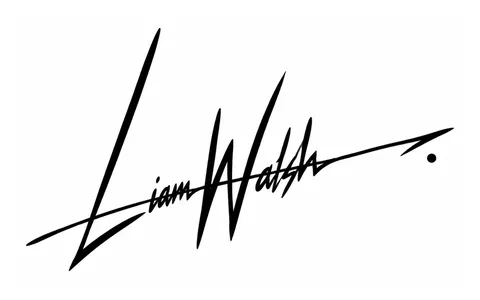
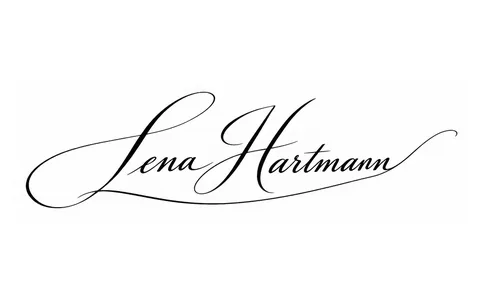
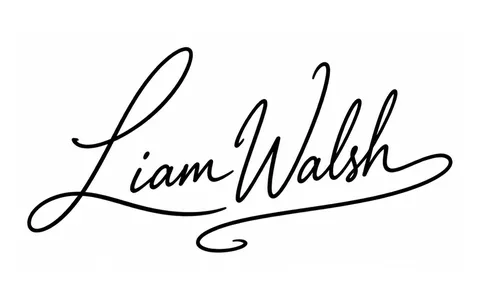
With a short name, the style makes a big difference: the same “Zoe Bell” looks completely different with elegant loops than with sharp, angular strokes. Calligra designs several different signatures from your name and teaches each one stroke by stroke with animation, so you can see side by side which one gives your short name the most character.
Try it with your name. You can read more about how styles differ in our article on signature styles.
The one sentence worth taking away
A short name becomes a full signature when you write the whole name, give it a bigger, livelier capital, make the most of ascenders, double letters and accents, and fill the line with a longer finish, without adding made-up letters or piling on decoration.
Questions
How can I make my signature look good if my name is short?
Write your full name, give the capital extra height and a sweeping entry stroke, and finish with an underline or a long tail. These add length and weight without adding letters.
Should I abbreviate my name in my signature if it's already short?
Usually not. With a short name, abbreviating saves almost no time but costs a lot of recognisability. Writing your full name is the best starting point for short names.
How big should the capital be on a short name?
It can be bigger than in an average signature, up to two and a half or three times the height of the lowercase letters. Keep the lowercase slanting the same way, and don't let the capital swallow the name.
Is it a good idea to decorate a short signature?
One or two main features are a good idea, such as a loop or an underline. Use too many at once and the short name disappears behind them, and the signature comes out differently every time.
What's a good signature for a three-letter name?
Write it with your surname, start with a tall capital and an entry stroke, use any tall or descending letter for structure, and close with a return underline or long tail. For example, “Amy Cox” with a deep “y” loop that sweeps back under the name.
Try it with your own name
Read these too
Knowledge For teens
Autograph vs signature: what's the difference, and which should you practise?
A signature identifies you; an autograph is a keepsake. Here's how the two differ, which one to practise first, and how to design an autograph that looks great without giving away your official signature.
 For teens
Signature ideas for long names: what to shorten and what to keep
If your name barely fits on one line, your signature can easily turn slow and cramped. Here's the order to shorten things in, what to always keep, and six long names worked through from start to finish.
 For teens
Your first official signature: ID, bank account and exams at 16–18
Somewhere between 16 and 18 your signature suddenly gets serious: it goes on an ID, at a bank, on exam papers and contracts. Here's where it's recorded first, why it pays to decide in advance, and how to prepare.