Knowledge › Practical
Practical
Initials, monograms, short signatures: when is the short form enough?
In the corner of a page, on internal paperwork, in a cramped box, a quick short mark comes in handy. Here's where it's usually accepted, where your full signature is more likely expected, and how to keep the short form unmistakably yours.
Nobody writes out a full, flowing signature on the corner of every page of a twenty-page contract, on an office memo, on an attendance sheet or in the margin of a draft. That's where initials, a short mark or a monogram go instead: two or three letters, one quick movement. The trouble is that short forms drift easily. A loop today, a tick tomorrow, two merged letters next week, and after a while even you couldn't say which one is the “real” version. A good short form isn't a new mark; it's a condensed version of your full signature: the same start, the same slant, the same rhythm, just less of it. In this article we sort out the terms, look at where a short form is common and where your full signature is more likely expected, show you how to derive the short version from the full one, and how to keep it the same years from now. If you'd rather simplify your full signature than shorten it, see the article on easy signatures. This isn't legal advice: where the stakes are high, the rules of the institution concerned always decide.
Initials, short marks, monograms: what's the difference?
In everyday speech we use these words loosely, and that's fine. But to make a deliberate choice, it helps to separate what they usually mean.
- Initials. A short, quick mark showing that you've seen, checked or approved a page or document. Often made of your initial letters, sometimes a single characteristic stroke.
- Initialling pages. Putting your initials on every page of a multi-page document, typically at the bottom or in a corner. The full signature still goes at the end, on the signature line.
- Monogram. A deliberately shaped, linked version of your initials. It can serve as your initials, but also as a decorative mark, for example in your own books, on drawings or on gifts.
- Short signature. A shortened version of your full signature: the capital and the first sweep stay, the end is dropped or simplified.
There's no hard line between the four, and you don't need all of them. Most people do perfectly well with two marks: the full signature, and one short form that works for initialling, approvals and tight boxes alike.
We cover designing a monogram letter by letter in the article on capitals. Here the focus is on when and where to use it, and how to keep it in step with your full signature.
Why a short form is useful
A short form isn't laziness; it's a tool. There are situations where a full signature simply isn't practical, or isn't what's being asked for.
- Many pages, many marks. If every page of a document needs initials, a short mark saves minutes, and your hand isn't worn out by the end.
- Tight spaces. In a table cell, a margin or a small box, a full signature gets squashed and distorted. A well-formed short mark stays clean there.
- Internal, less formal papers. On an internal approval, a receipt list or the margin of a draft, a short mark says: seen, fine. No more, no less.
- Clear roles. If the full signature belongs to the final decision and the initials to “I've checked this”, the paper shows what applies to what.
A short form is right where speed matters, but it never replaces being unmistakable.
Where a short form is usually enough
Whether a short form is accepted in a given situation isn't your call; it's up to whoever is asking for the paper. Still, there are typical situations where initials are normal, and typical situations where your full signature is more likely expected.
- Initialling each page of a multi-page document.
- Internal memos, approvals, routing slips.
- Attendance sheets, receipt lists, internal logs.
- Initials next to corrections or changes, if that's what's asked.
- Marking your own books, notes and drawings.
- The signature line of a contract, at the end of the document.
- Banking, where the bank keeps a specimen signature.
- Official and government documents and declarations.
- Matters involving a notary or certification.
- The signature field on identity documents.
Initialling: one mark per page
The point of initialling is usually to show, on every page, that you've seen that page and that it belongs to the document you signed at the end. So what matters here isn't beauty, but that the mark is the same on every page and always in the same place.
- 1Ask where it should go. Many places want it in the bottom right corner or in a small box set aside for it. If there's a marked spot, use it.
- 2Flick through first. Look over the whole document before you start. That way no page gets missed and you don't have to go back.
- 3Always write the same mark. The same short form on page one and page twenty, at the same size.
- 4Don't write over the text. Your initials shouldn't cover a line, a number or a date. If the margin is tight, make them smaller.
- 5Full signature at the end. Initialling doesn't replace the full signature on the signature line, unless you've been explicitly told otherwise.
Tessa Turner works in an office where she initials dozens of internal papers every week. For years she wrote a quick “T” that looked sometimes like a tick, sometimes like half a cross. When a colleague asked whether a particular page carried her mark, she honestly couldn't say for sure. Since then she's used a simple short form that never changes: the “T” from her full signature and the first small curve after it. Nobody asks whose it is any more.
Where your full signature is expected
With banks and official matters, it often isn't just about whether you signed, but whether the signature resembles the one you gave before. A bank may keep a specimen signature on file, and an identity document carries the signature you gave when it was issued. Writing a completely different short mark in those situations can raise questions.
- Don't switch on your own. If you've always used your full signature at the bank, don't suddenly change to a short form. If you'd like to, ask first whether that's possible and whether a new specimen is needed.
- The signature line is for the full one. At the end of a contract, where the space for your signature sits above or below your name, the full signature is usually expected, even if you've initialled the pages.
- On documents, what you gave. The signature on your identity documents is a kind of reference point. For official matters, it makes sense to sign in a way that matches it.
- If in doubt, ask. A quick question to the clerk or your bank saves a lot of hassle.
If you're changing your signature and want your short form to follow, changing your signature walks through where to register the new form and how to get through the in-between weeks.
Making the short form recognisable
A short form works well when anyone who knows your full signature immediately sees the short one as yours too. It doesn't need to be complicated; it just needs to start from your full signature.
- The same capital. The first letter of your short form should start exactly like your full signature's: from the same point, in the same direction, with the same loop or edge.
- The same slant. If your full signature leans right, the short form should lean right too. An upright mark next to a slanted signature looks like two different hands.
- The same rhythm. If your full signature is fluid, the short form shouldn't be slowly drawn. One movement, at the same tempo.
- At least one distinctive feature. A loop, an unusual connection, a characteristic curve: something that isn't a generic tick or circle.
- A sensible size. Roughly as big as the first part of your full signature. It doesn't have to be tiny, but it shouldn't grow bigger either.
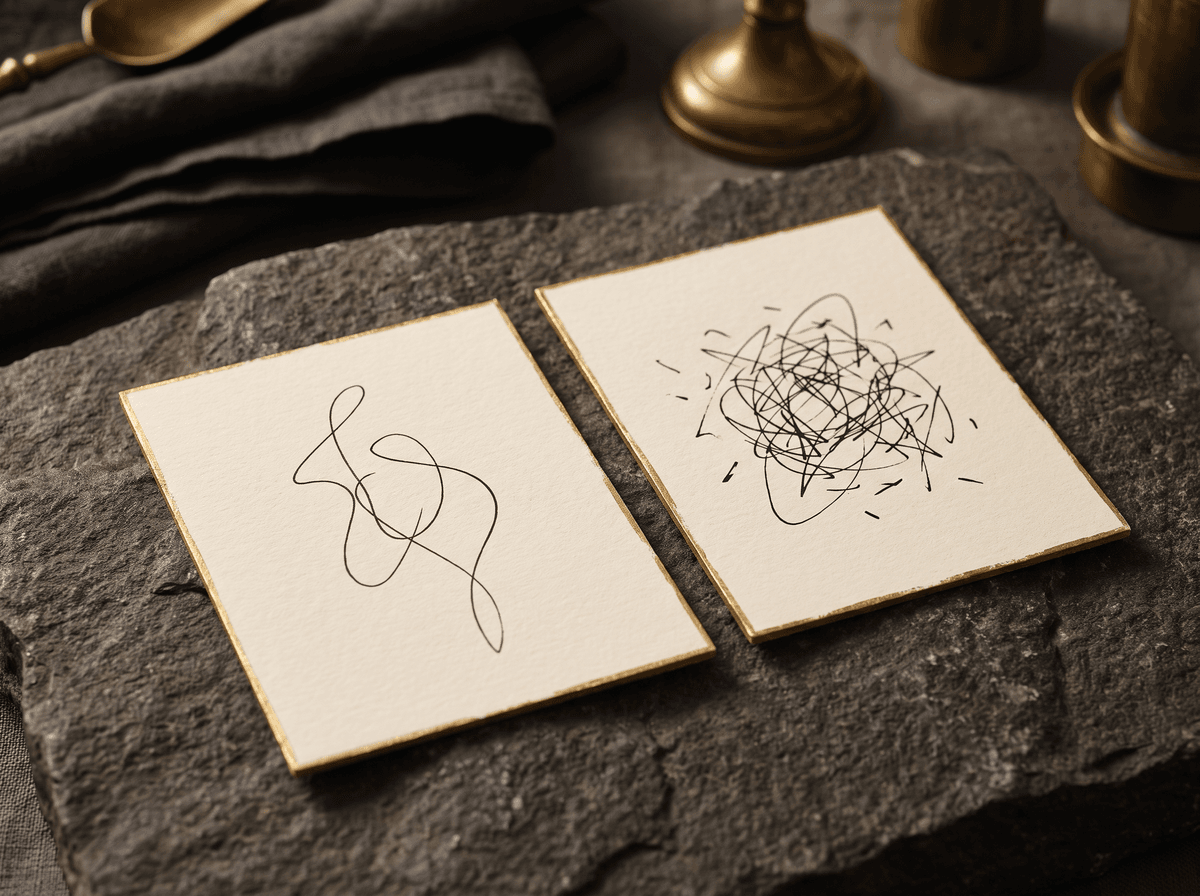
One family: full signature, short form, monogram
It's best when your marks form a family. The full signature is the parent, the short form is its first part, and the monogram is a compact version of your initials. Put side by side, they clearly belong together.
- 1Start from the full signature. Write your full signature ten times and see which part always comes out the same. Usually it's the capital and the first one or two letters or curves after it.
- 2Cut it where it feels natural. Look for the point where the pen slows down or changes direction on its own. End the short form there, with a short exit stroke.
- 3Add a second letter if needed. If your surname's initial matters too, attach it to the end of the short form. Same slant, same tempo.
- 4Try it in a small space. Write it in a two-by-two-centimetre square. If it's still recognisable there, you're on the right track.
- 5Settle on it. Pick the best one and write that from then on. Don't keep reshaping it every week.
If you design a new signature with Calligra, you also get a short version and a monogram alongside the full signature, so the family is born together from the start. But you can do it by hand too: what matters is that the short form grows out of the full one rather than living separately beside it.
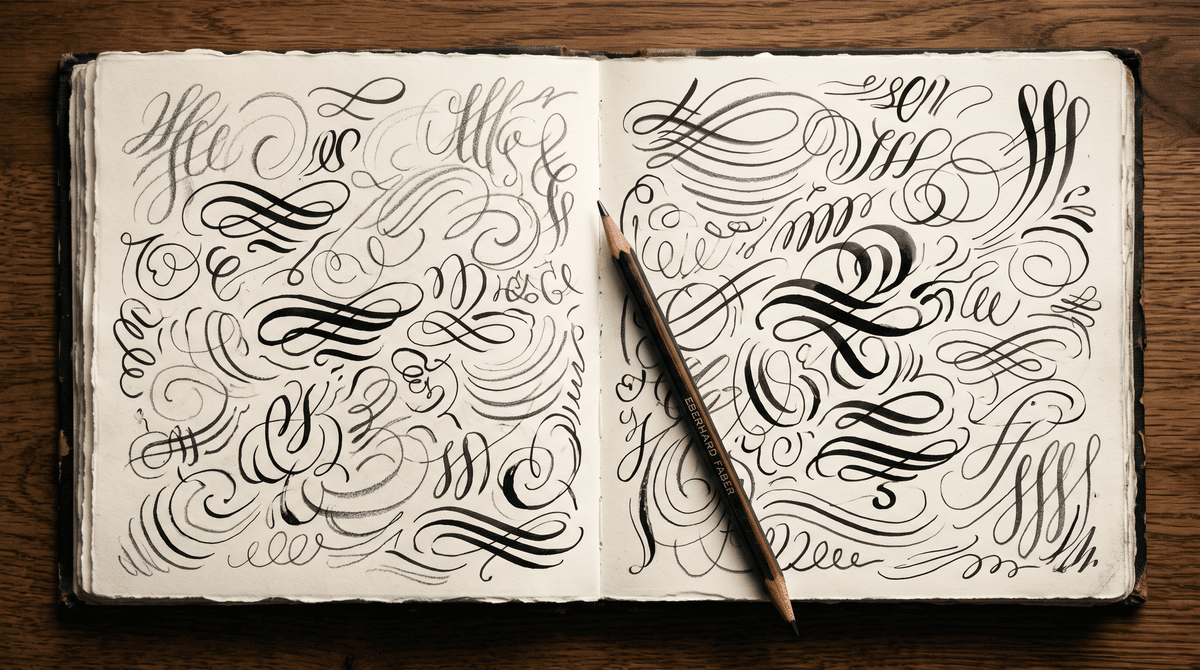
Consistency: always the same
The short form's worst enemy is variety. Because we write it quickly and often, the hand tends to improvise: longer one time, shorter the next, a loop here, none there. Yet what makes it recognisable is precisely that it's the same every time.
- One short form, not three. Don't keep one mark for work, another for parcels and a third for notes. One well-practised short form covers everything.
- The same with every tool. Ballpoint, fineliner, a finger on a screen: the shape stays the same; at most the line weight changes.
- The same in any situation. In a rush, standing, on the edge of a counter, write the same thing. If your short form only works when you're calm, simplify it.
- The same years from now. Once you've introduced it, don't swap it at every new job. If you do change it, do it deliberately, together with your full signature.

A short mark becomes yours by being written the same way the hundredth time.
Practice: ten identical short marks
Because a short form has so few strokes, it's quick to learn. A few days of short daily sessions is usually enough for your hand to write it on its own. The schedule below is a starting point, not a rule: adjust it to your own pace.
- 1Days 1–2: slowly. Write the short form slowly, ten times in a row, watching the starting point, the direction and the ending.
- 2Days 3–4: at speed. Write it the same number of times, but at your usual tempo. If the shape falls apart, slow down a little.
- 3Day 5: in small spaces. Draw a column of small squares and write one short mark in each.
- 4Day 6: next to the full one. Alternate between your full signature and your short form. Check that both start the same way.
- 5Day 7: check. Write ten short marks one under another and look at them at arm's length. If all ten are recognisably the same, you're done.
For more on practising in general, the practice article has a 7-day and a 21-day plan. Calligra's practice pad helps too: it shows you stroke by stroke how the shape is built.

Common mistakes and how to fix them
Most of the uncertainty around short forms comes from a handful of recurring mistakes. The good news is that each is easy to fix.
- Two unrelated marks. The short form looks nothing like the full signature. Fix: start the short form exactly the way you start the full one.
- Too generic. A tick or a circle that anyone could write. Fix: build in a recognisable shape of your capital and one distinctive feature.
- Different every time. Longer, shorter, with a loop, without. Fix: pick one and practise until you get ten identical marks.
- Short form instead of full. You write the quick mark at the bank or on official papers too. Fix: where the full signature is expected, write the full one, or ask in advance what's accepted.
- Too big or too ornate. The initials are bigger than the box, or slower than the full signature. Fix: simplify, and keep it the size of the first part of your full signature.
A checklist for your short form
Before you settle on your short form, run through this list. If the answer to everything is yes, you've got a practical, recognisable mark.
- 1Does it start like your full signature? Same starting point, same direction, same capital.
- 2Does it slant the same way? Side by side, the full and short forms lean in the same direction.
- 3Does it have a distinctive feature? Something that isn't a generic tick or circle.
- 4Does it fit in a small square? Still recognisable at two by two centimetres.
- 5Is it the same ten times out of ten? Of ten marks written one under another, none stands out.
- 6Do you know where not to use it? At the bank, on documents, on a contract's signature line, the full signature is the safe choice, or you ask beforehand.
The one sentence worth taking away
Make your short form the first part of your full signature, write it the same way every time, and use it where quick approval is the point, not where your full signature is expected.
Questions
Is my monogram enough on a contract?
For initialling the pages, often yes; at the end of the contract, on the signature line, the full signature is usually expected. What's acceptable for a particular contract is something the other party or a qualified professional can tell you, so if it matters, ask in advance.
Can I use a short signature at the bank?
Your bank can tell you. If the bank keeps a specimen signature on file, your signature is compared with that. Don't switch to a short form on your own: if you'd like to, ask whether it's possible and whether a new specimen is needed.
What's the difference between initials and a monogram?
Initials are a function: they show you've seen or approved a page. A monogram is a shape: a designed, linked version of your initial letters. A monogram can be your initials, but your initials can also be the first part of your full signature.
Can I have two different short forms?
You can, but it's not worth it. The more marks you have, the harder it is to write each one consistently, and the easier it is to mix them up. One well-practised short form next to your full signature covers almost every situation.
What if my short form is completely different from my full signature?
It's not forbidden, but for recognisability it's better if the two belong together. The simplest fix is to build the short form from your full signature's capital and first sweep, and practise it deliberately for a few days.
How big should my initials be?
Roughly the size of the first part of your full signature, and always small enough to fit the space provided. On a multi-page document it helps if they're the same size on every page and don't cover any text.
If I change my signature, should I change my short form too?
It's a good idea. If the short form came from the old signature, it won't match the new one. The easiest approach is to make the new short form the capital and first curve of the new signature, and practise the two together.
Try it with your own name
Read these too
Knowledge Practical
Changing your signature: when, where and how
You can adopt a new signature at any time, but how you roll it out matters. Here's where your signature is on file, what to ask, and how to get through the awkward first weeks.
 Practical
Signing on screens: tablets, phones, terminals
At the door with a courier, at the bank, at a café counter: more and more often we sign on glass with a finger or stylus. Here's how to keep your signature recognisable and good-looking there too.
 Practical
Signing PDFs and e-documents: what to watch for
Print, sign and scan? Paste in an image? Or are they asking for an e-signature? Here are your options, how to make a clean signature image, and how to keep your digital signature safe.