Knowledge › Basics
Basics
Does a signature have to be your name?
Full name, an initial, a monogram, a line or a doodle: what's generally accepted, what's risky, and how to find a middle ground that's quick to write but clearly yours.
Plenty of people are surprised to learn that in many places a signature doesn't have to be a readable version of your name. It can be an initial and a wave, a monogram, even a completely abstract mark. A signature counts because it's linked to you, shows your intent and is written the same way every time, not because it can be read letter by letter. That doesn't mean the choice doesn't matter. A bare line or a doodle can cause awkward moments in some situations, and occasionally a dispute. This guide walks along the scale from full name to plain line, looks at what speaks for and against each form, and shows where the sensible middle ground lies.
The short answer
As a general rule, many countries have no requirement that the letters of your name be legible in your signature. What a signature actually shows is that you made the mark and stand behind what you're signing. For that, the mark needs to be distinctive and consistent, not necessarily readable.
Two things complicate the picture, though. Some institutions set their own expectations, for example for an ID document or a bank. And the fact that something is allowed doesn't make it a good idea. Your name, or at least part of it, brings a lot of practical benefits.
So why is the name almost always there?
If it isn't required, why do most people still write their name? Because a name is the simplest way to tie a mark to you at first glance. A few reasons it's nearly always there in practice:
- It links the mark to your printed name. Anyone looking at the document sees a signature starting with an “O” above the printed name “Oliver Grant”. That's reassuring and unambiguous.
- It's easier to write consistently. Letters give you a skeleton. An abstract mark has nothing holding its shape, so it drifts more easily over the years.
- It helps if there's ever a dispute. If a question arises over whether you signed, a name-based signature full of personal movements offers far more details to compare.
- It's what people expect. Many clerks take a signature beginning with a name for granted. With a doodle or a dot, they may ask you about it.
The scale: from full name to a plain line
Signatures don't split neatly into “readable” and “unreadable”; they sit on a scale. Let's walk through it with “Oliver Grant”, from most readable to most abstract.
- 1. Full name: Oliver Grant. Both names written out in joined letters. The safest choice and ideal for a first signature. The downside is length, which can feel cramped in small boxes.
- 2. Initial and surname: O. Grant. Tidy and shorter. The surname is clearly readable, the first name just a hint.
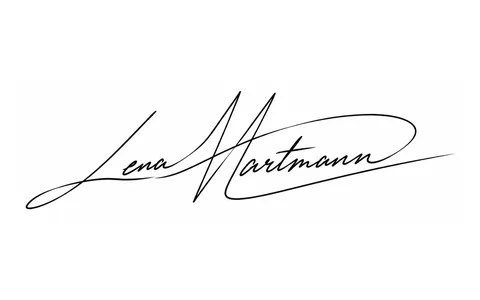
- 3. Readable start, flowing end. “Gra” can be read, the rest runs into an even wave. The most common adult signature.
- 4. Two initials and a line. A strong “O”, a smaller “G”, then a trailing stroke. Quick and modern, but the name can only be guessed.
- 5. Monogram. The two initials intertwined, nothing else. Excellent for initialling, but not accepted everywhere as a full signature.
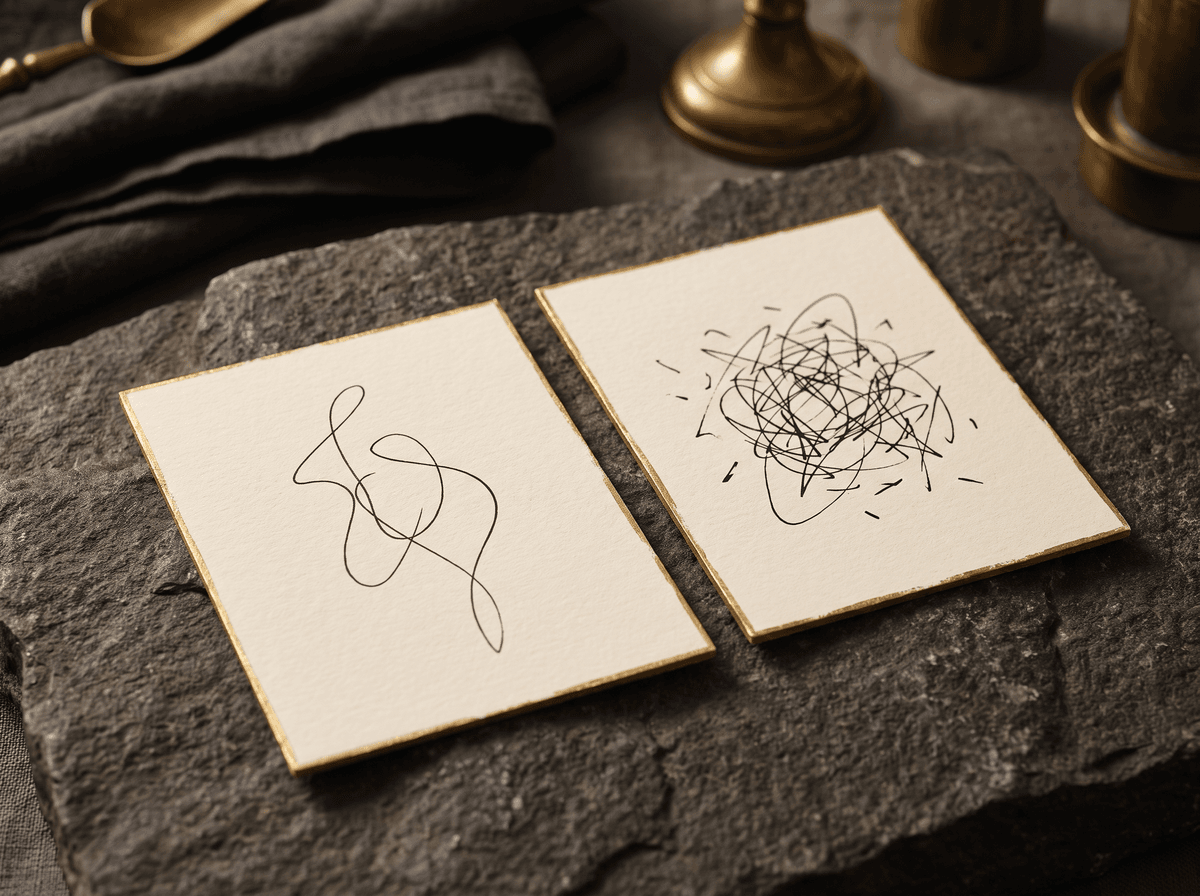
- 6. Abstract mark, line or doodle. A wave, a zigzag, a star. Fast, but nothing ties it to your name, and it's the most open to misunderstanding.
Most people feel at home in the middle of the scale, between steps 2 and 4. These are quick enough for everyday life and name-like enough that you won't have to explain yourself in official settings.
What speaks for an abstract mark?
An abstract, nameless signature has its advantages too, and it's easy to see the appeal, especially in your teens, when your signature is still taking shape in the margins of a notebook.
- It's fast. One or two movements and you're done. Handy at delivery terminals and card readers.
- It fits small spaces. A short mark goes into a tiny box more easily than a long name.
- It feels personal. If a shape is truly yours, it expresses your personality as much as a decorative name does.
Where a very abstract signature is risky
An abstract mark isn't forbidden, but there are situations where it can cause more trouble than it saves. Think about these before choosing a plain line as your official signature.
- Your first ID or passport. The signature on your ID card or passport becomes a reference for years. If it's too simple, your later signatures are harder to compare with it.
- A bank specimen. Your bank checks later signatures against your specimen. A line offers little to go on, so a slightly different version is more likely to be queried.
- If your signature is ever disputed. It's rare, but it happens. A personal, name-based signature offers far more details to compare than a line.
- If anyone could repeat it. Anyone can draw a straight line or a simple loop. The simpler the shape, the less it can be tied to you.
- If you can't write it consistently. Without letters, the shape drifts more easily. Today's wave can become a rather different wave in a year.

The middle ground: one readable anchor
For most people the best answer is a readable anchor: one element that clearly ties the mark to your name, while the rest is free to shorten. It might be the capital, the first syllable of your surname, or a distinctive, recognisable pair of letters.
- 1Choose your anchor. Usually the capital of your first name or surname, whichever starts your signature. If one of your names is more distinctive, use that.
- 2Make it clearly readable. Let the anchor be larger and cleaner than what follows. If only one letter in your signature can be read, make it this one.
- 3Let the rest shorten. After the anchor, the name can become a wave, a trailing line or a few loosely formed letters.
- 4Test it at speed. Write it fast ten times. If the anchor stays recognisable every time, you're in the right place.
We have a detailed guide to designing the capital, and this article covers the balance between legibility and personality.
First name only, a nickname, another name?
People often ask whether a signature can be just a first name, a nickname or even a pen name. In everyday life a lot is fine, but on official documents it's best to start from your legal name.
- First name only. Perfectly fine on a card, when signing a book or in a note to friends. An official signature usually needs your surname too, at least as an initial.
- Nickname. “Ollie” instead of “Oliver”: fine for informal moments, less so for official papers, because it won't match your printed name.
- Pen name or artist's name. Great on artwork, in books and as an autograph. On contracts and ID, use a signature linked to your legal name. The difference is explained here.
- Middle names. You don't have to write them all. Which to include, and how, is covered in a separate article.
Hearts, stars, smiley faces: are they OK?
If you started your signature as a teenager, you may have made it yours with a little drawing: a heart over the “i”, a star at the end, a smiley in a loop. In a notebook margin, on a postcard or on an autograph, that's charming and completely fine.
In an official signature, though, it's worth leaving out. Not because it's forbidden, but because a drawing slows the movement down, comes out a little differently every time, and as an adult you may not love seeing it on a contract. If you're attached to it, keep it in your autograph and make the official version simpler.
An autograph can be playful; an official signature should be repeatable.
If you already use an abstract mark
There's no need to worry if your signature has been a line or a wave for years. If you always write it the same way and it hasn't caused problems so far, there's no reason to change straight away. A few things are worth checking, though.
- 1Look at your specimens. Does your current signature still resemble the one on your ID or at your bank? If it has drifted a long way, consider updating it.
- 2Write it ten times, one under another. If the ten marks differ a lot, the shape is too loose. A readable anchor helps stabilise it.
- 3Think about where you'll use it. If lots of official signing lies ahead, a first job, a flat, a business of your own, now is a good moment to introduce a more name-like form.
If you decide on a new form, don't let it creep in gradually; switch deliberately, all at once. Our guide to changing your signature covers the practical steps.
Help deciding: three questions
If you still can't decide how much of your name to include, answer these three questions honestly.
- Where will you sign most? If mostly on terminals and in small boxes, a shorter form is your friend. If on contracts and official papers, a more name-like one.
- Will it be compared with a specimen anywhere? If so, for an ID or a bank for example, choose a form with a clearly readable anchor.
- Can you write it the same way ten times? This is the most important question. The form that stays consistent at speed wins, however readable it is.

If you'd like to see your name at different points on the scale side by side, in Calligra you can try many styles that handle the capital and the length of your name differently, then teaches the one you pick stroke by stroke. Try it with your name.
The one sentence worth taking away
In many places your name doesn't need to be readable in your signature, but one readable anchor, such as a clean capital, ties the mark clearly to you even at speed and spares you questions in official settings.
Questions
Can I sign with a simple line?
Many places have no rule against it, but a bare line is easy to imitate, hard to compare with a specimen, and may be queried in official settings. If you want a short form, include at least one clearly readable initial.
Can my signature be just my first name?
In informal situations, yes, such as on a card or when signing a book. Official documents usually include your surname too, at least as an initial. What a particular institution expects can vary.
Is it a problem if my name isn't readable in my signature?
Usually not. Many adult signatures are readable only in the capital. What matters is that the mark is distinctive and that you always write it the same way.
Can I sign with my nickname?
In informal situations, yes. On official documents it's best to start from your legal name, because your printed name usually appears next to the signature and the two then clearly belong together.
Can I draw a heart or a star in my signature?
In an autograph, on a card or in a notebook, go ahead. In an official signature it's best left out, because it slows the movement and comes out a little differently every time.
Is an unreadable signature more secure?
Not necessarily. A simple, abstract mark is often easier to imitate than a name-based signature with lots of personal details. Security comes from a distinctive, practised movement.
Try it with your own name
Read these too
Knowledge Basics
What makes a signature look professional?
It isn't the number of flourishes. Flow, a strong capital, a consistent slant, good proportions and a clean finish make a signature confident and repeatable.
 Basics
How legible should your signature be?
Not every letter needs to be readable, but pure chaos isn't the answer either. Here's how to find the balance between legibility and personality.
 Basics
What does a signature reveal? Graphology myths and facts
A big capital, a long underline, a rightward slant: many people believe these reveal our character. Here's an honest look at what a signature can and can't tell you.