Knowledge › Style
Style
Signing a double-barrelled or hyphenated surname: how to keep it beautiful and quick
Two surnames, a hyphen, two capitals, and a signature box that hasn't got any longer. Here are the four solutions that work, and what to watch out for when the double name comes from marriage.
A double-barrelled surname brings two problems to a signature at once. The first is length: “Emma Clarke-Hughes” has almost twice as many letters as “Emma Clarke”, so the signature either becomes slow or falls apart at the end. The second is emphasis: suddenly two capitals compete with each other, and the eye doesn't know where to look. The good news is that a double name can still make a quick, consistent signature, as long as you decide in advance which part carries the character and which part just follows. In this article we go through what to check about your legal name, show four solutions that work, and deal with the hyphen, the two capitals, tight spaces, and what to do if the double name became yours through marriage. This isn't legal advice: what's accepted in a given place is always decided by that institution's rules.
Why is a double name harder?
A signature works well when you can write it in one calm movement and it comes out the same every time. A double name makes that harder in three places.
- Length. The more letters, the more chances for something to drift. After the tenth letter most hands start to hurry, and the shape begins to slip.
- Two capitals. Both surnames start with a capital, and with the first name there are suddenly three prominent letters in a row. If all three carry the same weight, the signature looks crowded and restless.
- The hyphen. A tiny stroke in the middle of the name that breaks the flow. If it lands somewhere different each time, or is there one day and gone the next, the signature is never consistent.
- Space. Card signature strips, form boxes and couriers' screens didn't get any longer just because your name did.
None of this is insurmountable. Each has a simple, deliberate decision behind it, and once you've made those decisions your hand learns the shape quickly.
First check: what exactly is your legal name?
Before you start designing, take out your ID card or passport and look at exactly how your name appears. That's your starting point, because banks, offices and contracts will link your signature to that name.
- With or without a hyphen? “Clarke-Hughes” or “Clarke Hughes”? The hyphen isn't required in a signature, but it helps to know the official form so you can decide deliberately.
- Which name comes first? With a double surname, the order is part of the name. It's worth following it in your signature too, or the printed name and the signature won't match.
- What order with your first name? In English the first name usually comes first; in some countries, such as Hungary, the surname does. In a signature the natural order is usually the one you use when writing your name day to day.
Four solutions that work, with the same name
We show all four solutions on the same name, so only the solution changes. None is “the right one”: each works well in different situations and for different hands.
Both names written out: “Emma Clarke-Hughes”. The clearest solution: anyone who sees it reads your full name straight away. It works if both surnames are short, or if you sign a lot of official papers where the full name matters. The cost is length: it's hard in small spaces, and without practice the end easily drifts.
The first surname as an initial: “Emma C.-Hughes”. Only the capital of the first surname stays, with a full stop and the hyphen, and the second is written out in full. The double name doesn't disappear, yet the signature gets much shorter. For many people this is the happy medium. If the second name matters more to you, this is the one to choose.
The second name shortened: “Emma Clarke-H.”. The reverse logic: the first surname in full, the second as just a letter or two. It works if the capital of the first surname is a beautiful, prominent shape and you'd like it to carry the signature. Make sure the abbreviation is always the same number of letters, or every signature will be different.

In one movement: “Emma Clarke-Hughes”. Here the first-name capital leads, and the two surnames follow in one long, flowing line. The hyphen becomes little more than a brief pause in the pen. It's the fastest form, but only as long as the capital stays recognisable along the way.
A double name isn't twice the signature. It's one signature with two names sharing the space.
The hyphen: write it, drop it, or join it?
The hyphen is the smallest part of your name, yet it decides whether the two surnames read as one or as two. There are three ways to handle it, and any of them is fine if you always choose the same one.
- 1A short, decisive stroke. The clearest: after the first name you lift the pen, draw a short horizontal line and carry on. Always the same length, always in the same place, roughly at the height of the middle of the lowercase letters.
- 2A joined transition. The hyphen isn't a separate stroke but a short curve running out of the last letter of the first name and turning into the capital of the second. Faster, and the two names look like one whole.
- 3Dropped. In many signatures there simply is no hyphen; the two names follow each other with a small gap. It's the quickest, and perfectly fine in most everyday situations.
Whichever you choose, consistency is what counts. The most telling mistake isn't a missing hyphen; it's a hyphen that's there one time and not the next, long once and a dot the time after.
Two capitals in one signature
The biggest design question with a double name is which capital plays the lead. If they're all equally tall and ornate, the signature looks as if two people had signed the same paper.
- Pick a lead. Let one capital be really tall and distinctive and the others more restrained. Usually it's the first one, the one the signature starts with.
- Make the second one lower. About two-thirds the height, and simpler in shape. That way the eye starts on the first and simply moves on past the second.
- The same slant. The two capitals should lean in exactly the same direction, or the name reads as two separate pieces.
- One ending, at the end. Don't give each name its own underline. One shared, short ending under the whole name holds it together.
How to design a capital step by step is covered in detail in the article on capitals. The article on endings helps you choose a finishing stroke.
Tight spaces: cards, forms, screens
A double name suffers most in small signature boxes. The answer isn't to squash everything, but to have a shorter version you've practised in advance, one that grows out of the full one.
- The signature strip on the back of a bank card.
- Tight form boxes and table cells.
- Courier and card-terminal screens.
- Attendance sheets and receipt lists.
- The signature line of a contract.
- The signature field on documents.
- Banking, where a specimen signature is kept.
- Notarial and official papers.
The shorter form should be the first part of your full signature: the same start, the same slant, with only the second surname dropped or shortened. We cover this in detail in the article on small spaces and the article on short forms.
If the double name comes from marriage
For many people the double surname arrives with the wedding: they keep their own and add their spouse's. The signature then isn't just longer but new, and it's worth introducing it deliberately. How to rebuild your old signature around the new name is covered in detail in a separate article.
- 1Keep what was yours. If your old signature started with your own surname and you like its capital, you don't have to give it up. Often it's enough to add the new name after the old form, in a shorter way.
- 2Decide which name leads. If the new name comes first and becomes the first capital, the character of the signature changes too. That's fine; just know in advance what you're choosing.
- 3Practise before it becomes official. On your new documents, at the bank and at work, this signature becomes the specimen. It helps if it already comes naturally by then.
- 4Let people know where needed. Wherever a specimen signature is kept for you, ask whether you need to give a new one. Changing your signature describes the steps.
Emma Clarke-Hughes spent two weeks after her wedding trying out how to sign her new name. In the first days she wrote both surnames out in full, and at the bank it barely fitted on the edge of the counter. By the third day she was adding just a short hyphen after “Clarke” and joining “Hughes” on in one sweep, with a small, short ending. She kept the big looped “C” from her old signature. By the time she collected her new passport, the shape was in her hand.
Common mistakes and how to fix them
Problems with double names almost always come from the same few mistakes.
- A different solution every time. Full once, shortened the next, then just one name. Fix: pick one of the four solutions and stick to it.
- Two identical capitals. Both surname capitals are the same size and equally ornate. Fix: let one lead and make the other two-thirds the size.
- A wandering hyphen. Long, then a dot, then missing. Fix: decide which kind you use and practise it in.
- The end falls apart. The first name looks good, the second is just a wavy line. Fix: shorten the second name, or slow down a little at the end.
- No shorter version. In small spaces the full form gets squashed. Fix: practise a shorter one that grows out of the full one.
A week of practice
Once you have the shape, a few days of short daily practice is usually enough for your hand to write it on its own. This is a starting point; adjust it to your own pace.
- 1Days 1–2: slowly, in parts. Write the two surnames separately, then together with your chosen hyphen. Watch the proportion between the two capitals.
- 2Days 3–4: in one movement. Write the full signature ten times, one under another, at your usual pace.
- 3Day 5: in small spaces. Draw card-sized rectangles and write the shorter version inside them.
- 4Days 6–7: check. Put ten signatures side by side. If the capitals, the hyphen and the ending are the same on every one, you're done.
A more detailed 21-day version is in the practice article. And if you don't yet know what style you'd like, the style quiz suggests one from eight questions and shows your own name in it.

The one sentence worth taking away
With a double name, decide in advance: which capital leads, how you handle the hyphen, and what your shorter version for tight spaces is. Write those three the same way every time, and even a long name becomes a quick, consistent signature.
Questions
Do I have to include both surnames in my signature?
Usually not. A signature typically doesn't have to spell out your full legal name letter by letter, but it helps if it's recognisably linked to it. For official matters the fuller form is the safer choice; if you're unsure, ask the institution concerned in advance.
Do I have to write the hyphen?
No. It can be a short separate stroke, a joined transition, or you can leave it out. What matters is that you always use the same solution.
Which surname should be more prominent?
Usually the one the signature starts with, whose capital is a beautiful, distinctive shape. Make the other about two-thirds the size and simpler, so they don't compete.
What if it doesn't fit on my card?
Practise a shorter version that is the first part of your full signature: the same start and slant, with the second surname shortened or dropped. Use it for tight spaces.
Do I have to use a new signature right after the wedding?
Not immediately, but it helps if the shape is in your hand by the time you get your new documents, because from then on it becomes the specimen. Wherever a specimen signature is kept for you, ask whether you need to give a new one.
Try it with your own name
Read these too
Knowledge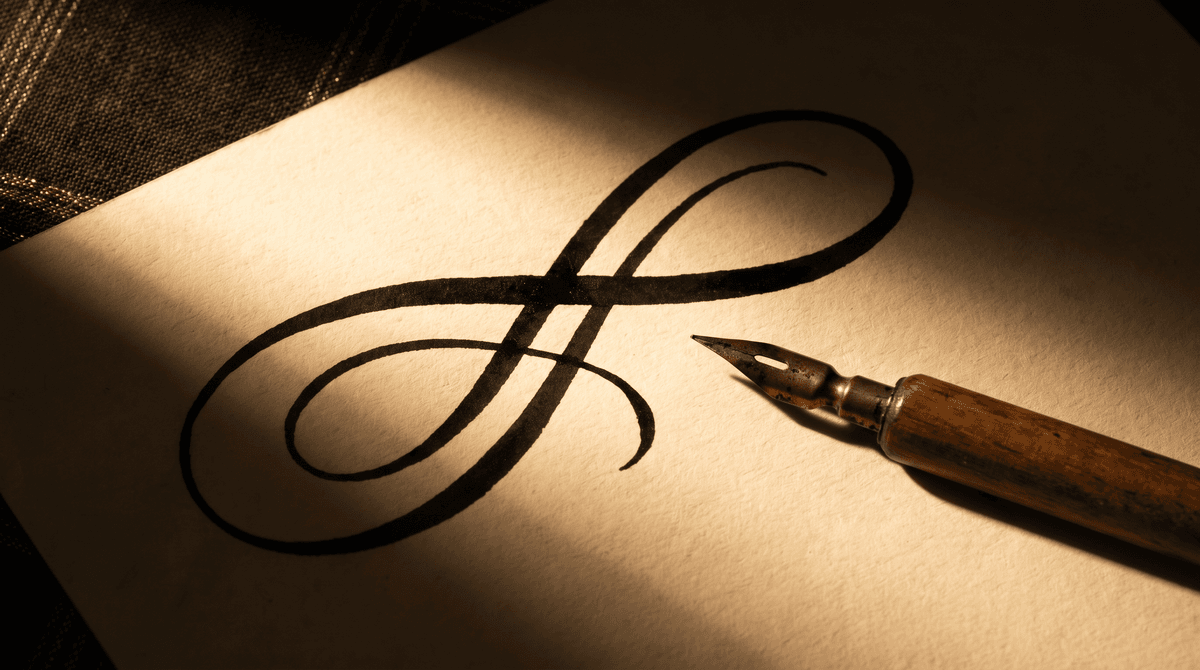 Style
Designing the capital: the face of your signature
The first letter carries the character, the rhythm and most of the recognisability. Proportion, entry strokes, loops, connections and simplification, step by step.
 Style
Underline, loop or tail? Finishing your signature
The last stroke sets the tone of a signature. Here are the most common finishes, what each one says, and how to pick the one that fits your name and the places you sign.
 Style
Middle names and nicknames: what goes into your signature?
Emily Rose, whom everyone calls Rosie. James Edward, who has gone by Ned since he was a baby. If you carry more than one name, your signature makes you choose: both, just one, an initial or the nickname. Here's when each one works.