
Knowledge › Style
Style
Middle names and nicknames: what goes into your signature?
Emily Rose, whom everyone calls Rosie. James Edward, who has gone by Ned since he was a baby. If you carry more than one name, your signature makes you choose: both, just one, an initial or the nickname. Here's when each one works.
Most signature advice starts with “write your name”. The trouble is that many of us don't have just one. Your birth certificate lists a first and a middle name, your family uses a shortened form, and your friends use another one altogether. The first time you have to sign something that matters, the question suddenly appears: which of my names goes on the paper? The good news is that there's no single right answer, and a signature usually doesn't have to spell out your full legal name letter by letter. What matters is that the form you choose is yours, stays quick to write, and comes out the same way every time. In this article we go through the options, from writing both names to a middle initial to a nickname, look at when each works well in everyday life and in official situations, and give you a simple test to find the form that's yours. This isn't legal advice: where the stakes are high, the rules of the institution concerned always decide.
Why is this even a question?
If you have one first name and that's what people call you, this rarely comes up. For everyone else, it almost always does. Middle names are common in many countries: often a grandparent's name, a godparent's, or a family tradition. Some people have two or three, and in some places a person can carry several given names at once.
Meanwhile, in daily life we often live under a different name. Elizabeth becomes Liz or Beth, Alexandra becomes Sasha, Robert becomes Bob. Some people go by their middle name because the first one was already taken in the family. And some have a nickname that looks nothing like the official one.
- The legal name. What appears on your birth certificate, your ID and your contracts, together with your surname.
- The name you use. What people call you at work, at school, among friends. It can be your first or your middle name.
- The nickname. The shortened, affectionate or entirely different form only the people closest to you use.
A signature sits somewhere among these three. It isn't a way of writing out your name; it's a mark that stands for you. That gives you room to choose, but it's worth choosing deliberately, because whatever you settle on you'll be writing for years.
What does a signature need to contain?
Many people assume a signature has to reproduce their full legal name. In practice, a large share of signatures consist of little more than a capital and a fluid line, and are perfectly well accepted. What usually matters isn't whether every letter can be read, but whether the mark is yours and whether it resembles the one you've given before.
- Recognisability. Someone who has seen your signature should know it again. That doesn't require every name, but it does require a distinctive form that's always the same.
- Consistency. The same form at the bank, at work and when you sign for a parcel. The biggest mistake isn't picking the wrong name; it's switching between several.
- A reference point. The signature on your documents and on file at your bank is a specimen that later ones are compared with. It makes sense to stay close to it.
We've written about how readable a signature should be in a separate article. Here the question is which name forms its basis.
Five possible routes
If you have a middle name or a strong nickname, you can choose between roughly five directions. Each can work, and each comes at a different cost.
- 1First name and surname only. The most common and simplest option. The middle name is left out, and the signature stays short and quick.
- 2Both given names written out. Fuller and more formal, but longer. It works well with short names; with long ones it easily drags on.
- 3First name plus middle initial. A small initial between the first name and the surname. It keeps the middle name without slowing you down.
- 4The name you go by. If you live under your middle name, that goes into the signature, with the first name as an initial at most.
- 5The nickname. Personal and friendly, but best handled with care in official situations.
The surname stays in almost every version, at least as an initial. It's your family link, and it's what most documents look for next to your name. The order of first name and surname differs between countries; most people simply follow the order they use when writing their name in everyday life.
The question isn't how many names you have, but which one you can sign with the same way every day.
Two given names: when to write both
Writing out both given names works well when both are short, when the middle name matters to you, or when the two names read as one unit. “Amy Lou Kerr” can still be written comfortably in one movement. “Alexandra Christina Fitzgerald-Hughes” can't: written out in full it becomes slow, and the end will almost certainly fall apart.
- A fuller, more formal look.
- Sets you apart from people with similar names.
- Keeps the family meaning of the middle name.
- With short names, barely slows you down.
- Longer, needs more space.
- More strokes, harder to write the same every time.
- Gets squashed in small boxes.
- Hard to fit on a screen with a finger.
A simple yardstick: count the letters in your given names and surname. If together they come to roughly fifteen or fewer, writing both given names may still be comfortable. If it's a lot more, it's worth shortening the middle name to an initial. That's not a rule, just a starting point: your hand and your tempo decide.
The middle name as an initial
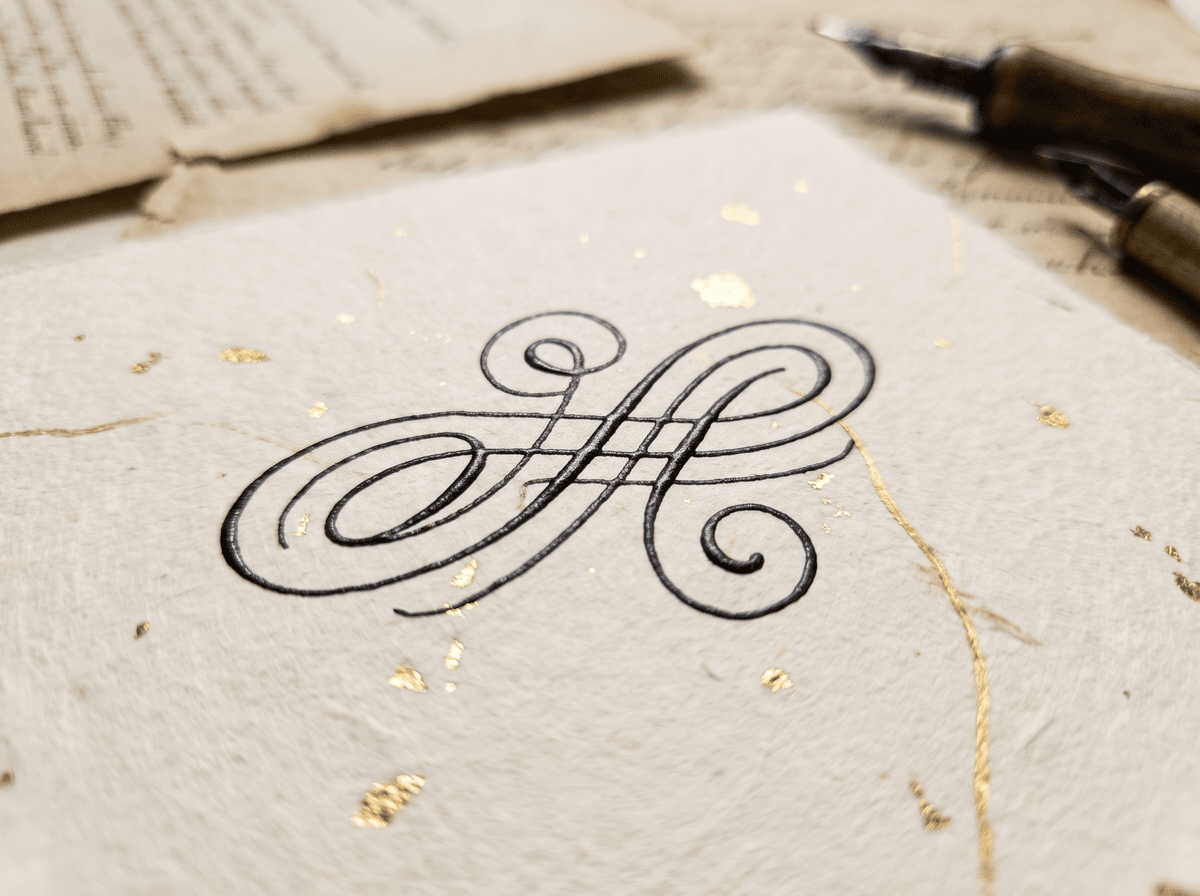
For many people this is the happy medium. The middle name doesn't disappear, but it doesn't have to be written out. A small initial after the first name, or both given-name initials intertwined at the start: that way the signature keeps your full name while barely growing in length.
- Where does it go? Usually after the first name and before the surname: “Emily R. Carter”. In countries where the surname comes first, it can also go at the end.
- Full stop or not? A full stop is cleaner and clearer, but it's an extra movement. In a quick signature, the initial with a short exit stroke is enough, as long as you always write it the same way.
- How big? Smaller than the first capital. If it's the same size, the eye sees two equal names and the signature's centre of gravity shifts.
- Same slant. The added initial should lean the same way as the rest of the signature, or it will look like an afterthought.
Another option is to link the two given-name initials at the start, like a monogram. This looks especially good when the two letters suit each other, for example E and R, or J and E. We show how to design a capital step by step in the article on capitals.

If you go by your middle name
It's more common than you'd think: someone is registered as Anna Marie, but everyone has called them Marie since birth. A signature starting with an “A” that nobody connects with them would feel odd. The signature can belong to the name you use, with the first name appearing before it as an initial at most.
- Put the name you use at the centre. Its capital should be the large, prominent letter, because that's the name people know you by.
- The first name can be a small initial. An “A.” before the name you use points to your full legal name, and can help on official documents.
- Stay close to what you've already given. If your bank or your ID already holds a particular form and you want to change it, find out first where you'd need to register the change.
If this makes you want to change your existing signature, changing your signature explains where specimen signatures are kept and how to introduce the new form.
A nickname in your signature: everyday and official
A nickname is the most personal choice. A signature starting with “Rosie” or “Ned” is friendly, relaxed and often much faster than the full name. The question is where you use it.
- Greeting cards, letters, gifts.
- Drawings, your own work, notes.
- Autographs, if it ever comes to that.
- Papers among friends, family and community.
- Contracts, banking and official matters.
- The signature field on documents.
- Papers from your employer or school.
- Anything where your signature is compared with a specimen.
In official situations the problem isn't necessarily the nickname itself, but that there's no visible link between a signature built from a nickname and the full name printed on the paper. If someone sees a signature starting with “Ned” above the name “James Edward Collins”, they may reasonably ask. So if your nickname is the basis of your signature, it helps to keep at least your surname, or its initial, in it.
When the nickname starts with the same letter
You're in luck if your nickname and your legal name start with the same letter: Katherine and Kate, Daniel and Dan, Alexandra and Alex. The capital is shared, so the first and most distinctive part of your signature suits both names. The part after the capital can be so short and fluid that the difference hardly shows.
If the two names start with different letters, such as Elizabeth and Betty, or Margaret and Peggy, there's no shared start. Then it's cleaner for the official signature to start from the legal name, and for the nickname form to live separately, in personal situations only.
Emily Rose Carter works in an office, and everyone has called her Rosie since she was little. For years she had three signatures: one starting with “Emily” for the bank, one starting with “Rosie” for colleagues, and a monogram-like “ER” for the attendance sheet. One day a colleague put two papers in front of her and asked which one was hers. Both were. Since then she's used one signature: a big looped “E”, a small “R” after it, and her surname in one sweep. “Rosie” stayed on birthday cards.
How to decide: the ten-times test
If you can't decide which version is yours, don't decide in your head; decide on paper. A simple test usually shows within a few minutes which form comes naturally to your hand.
- 1Write down the candidates. Three or four versions at most: for example both given names, first name with middle initial, the name you go by, the nickname with surname.
- 2Each one ten times. One under another, at your usual tempo. Don't prettify it; write it the way you would at a counter.
- 3Time yourself. If one version is much slower than the others, it will be hard to write it consistently in daily life.
- 4Try it in a small space. Write it inside a rectangle the size of a card's signature strip. Whatever holds together there is a good candidate.
- 5Look at arm's length. Which row has the ten most alike signatures? That's usually your form.
- 6Ask someone. Show a friend or family member: which one would they say looks like you?
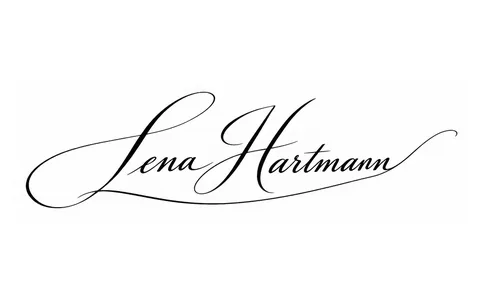
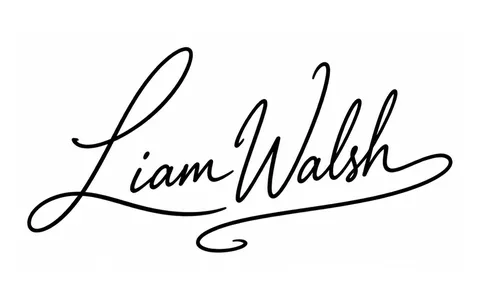
Calligra designs from your first name and surname and leaves middle names out. If you'd like to sign with your middle name or your nickname, simply type that as your first name, and you can try out which version suits your hand better.
One signature, several names?
You might wonder whether to use a full signature with both given names in official places and a shorter one in everyday life. That can work if the shorter one is the first part of the longer one, not a different name. If the two forms start from different names, though, they're really two separate signatures, and they're easy to mix up.
- One main signature. The one you use at the bank, on documents and on contracts.
- One short form. The first part of the main signature, for initialling and tight spaces. We cover it in detail in the article on short forms.
- A personal form, if you want one. The nickname version for letters and gifts, deliberately kept apart from the official one.
Any more than that becomes a burden rather than a help. The more versions you have, the harder it is to write each one consistently.

Common mistakes and how to fix them
Most uncertainty about which name to sign with comes from a handful of recurring mistakes. Each can be fixed, usually with one deliberate decision and a few days of practice.
- A different name for every situation. First name for the bank, middle name at work, nickname for friends. Fix: one main signature everywhere, and at most one personal form, kept deliberately apart.
- Too long because every name is in it. Two given names, a double-barrelled surname, and it falls apart at the end. Fix: shorten the middle name to an initial and let a strong capital carry the character.
- A nickname on official papers. A signature starting with “Ned” above “James Edward Collins”. Fix: in official places, a signature that starts from the legal name is the safe choice.
- The added initial sticks out. Its size or slant differs from the rest. Fix: smaller than the first capital, leaning the same way.
- The name you use is missing. Everyone calls you Marie, yet your signature says “Anna”. Fix: make the name you use the prominent one, with the first name as an initial at most.

A checklist for choosing your name
Before you settle on which name or names go into your signature, run through this list. If the answer to everything is yes, you've chosen a good basis.
- 1Does it reflect the name you live by? The prominent capital is the first letter of the name you use.
- 2Can it be linked to your legal name? At least your surname, or its initial, is in it.
- 3Is it quick to write? Not noticeably slower than is comfortable at a counter.
- 4Does it fit in a small space? It holds together in a card's signature strip.
- 5Is it the same ten times out of ten? In the ten-times test, this version was the most consistent.
- 6Do you have one main form? You write the same at the bank, on documents and at work; the nickname version lives in personal situations only.
The one sentence worth taking away
Your signature doesn't have to contain all your names: choose one form that's built on the name you go by, can be linked to your legal name, and that you can write the same way every day.
Questions
Do I have to include my middle name in my signature?
Usually not. A signature typically doesn't have to spell out your full legal name letter by letter; many signatures are just a capital and a fluid line. What matters is that you write it the same way every time and that it resembles the one you gave your bank or on your documents. If you're unsure about a specific matter, ask the institution concerned in advance.
Can I sign with my nickname?
In everyday, personal situations, such as letters, cards and gifts, by all means. On official documents, contracts and at the bank, a signature that starts from your legal name, or at least contains your surname, is the safer choice. That way the link between the printed name and the signature is visible.
Should I use my first or my middle name?
The one you live by. If everyone calls you by your middle name, the prominent capital of your signature can be that name's letter, with your first name as a smaller initial before it.
Where does the middle initial go?
Most often after the first name and before the surname. In countries where the surname comes first, it can also go at the end. What matters is that it's smaller than the first capital and slants the same way as the rest of the signature.
Can I have separate signatures for my legal name and my nickname?
You can, but keep them deliberately apart: the official form goes everywhere your signature is compared with a specimen, the nickname form only in personal situations. The more forms you have, the harder it is to write each one consistently.
If I change which name I sign with, do I need to tell anyone?
If your bank or an office keeps a specimen signature for you, it's worth asking in advance whether you need to give a new one. Changing your signature explains step by step where it's worth registering the new form.
My name is long and I have a middle name. What should I leave out?
Most often, shorten the middle name to an initial and keep the surname, at least its capital and a fluid continuation. A strong, well-formed capital often gives a long signature more than lots of written-out letters.
Try it with your own name
Read these too
Knowledge Style
Designing the capital: the face of your signature
The first letter carries the character, the rhythm and most of the recognisability. Proportion, entry strokes, loops, connections and simplification, step by step.
 Style
Underline, loop or tail? Finishing your signature
The last stroke sets the tone of a signature. Here are the most common finishes, what each one says, and how to pick the one that fits your name and the places you sign.
 Style
Signature styles up close: what makes a signature elegant, modern or precise?
Eight styles, all drawn with the same name. Here's which strokes make a signature elegant, dynamic or precise, and where each one holds up in everyday life.