Knowledge › Style
Style
Accents in your signature: é, ö, č, ł and the rest
An accent can be a stray dot, or one of the nicest details in your signature. When to add it, what shape to give it, how it survives haste and screens, and what to do with Czech, Slovak, Polish, Romanian, Turkish or French letters.
If your name has an “é”, an “ö” or a “č” in it, you know the moment: the name is done, the pen wants to swing into the finish, but you have to go back for a tiny mark. In a hurry, that mark lands too far away one day, shrinks to a dot the next, and disappears the day after. An accent in a signature isn't a spelling obligation; it's a separate movement worth deciding on deliberately: keep it, merge it or drop it, but always the same way. This guide shows how to make an accent part of the design, when and in what order to add it, and how the same questions play out for Hungarian, Czech, Slovak, Polish, Romanian, Turkish and French names.
A detail or a stray dot?
Accents sit above or below the letter, so they're almost always a separate movement: the pen has to lift, jump somewhere and come back. If you don't plan that movement, your hand solves it slightly differently every time, and the smallest element of your signature becomes the least consistent.
Plan it, though, and an accent can add rhythm. A short, slanted stroke above the line echoes the slant of the signature; the two little parallel strokes of a Hungarian double acute look like a small flourish no other signature has. The difference isn't talent; it's whether you decide in advance how you'll write it.
An accent isn't an obligation; it's a decision. If you keep it, put it in the same place, the same way, every time.
Do you have to include it at all?
A signature isn't the spelling of your name; it's a personal mark. So you're generally free to decide whether your accents appear in it. There are three well-tried approaches, and any of them can be the right one.
- Keep it. The accent is visible as a separate stroke. Worth it if your signature is mostly readable and the name would look odd without it.
- Merge it. Build the accent into another stroke: the entry stroke of the capital, a loop, the finish. You can tell it's there, but you don't have to go back for it.
- Drop it. If your signature can't be read letter by letter anyway, nobody will notice the missing accent. This is the fastest option.
The kinds of accents at a glance
European languages use many marks above and below letters. For a signature, what matters isn't their name but the movement they ask for. Seen that way, they fall into six groups.
- Acute: á, é, í, ó, ú. Hungarian, Czech and Slovak, the Polish ó, ś, ć, ń, ź, and the French é. One short, slanted stroke, the easiest to build in.
- Double acute: ő, ű. Hungarian only. Two short, parallel strokes, or a single slightly longer slanted line.
- Dots (umlaut, diaeresis): ö, ü, ä, ë. Two dots side by side. In signatures they often become two tiny strokes or one short horizontal dash.
- Háček and circumflex: č, š, ž, ř, ě, â, î, ê. A small “v” or a small upside-down “v”. Written with one quick, tick-like movement.
- Marks below the letter: ç, ş, ș, ț, ą, ę. Tails and commas under the baseline. Often written in the same movement as the letter.
- Special marks: ł, ů, ż, ı, ă, ğ. A bar, a ring, a dot above, a dotless i, a breve. Each has its own quick solution.
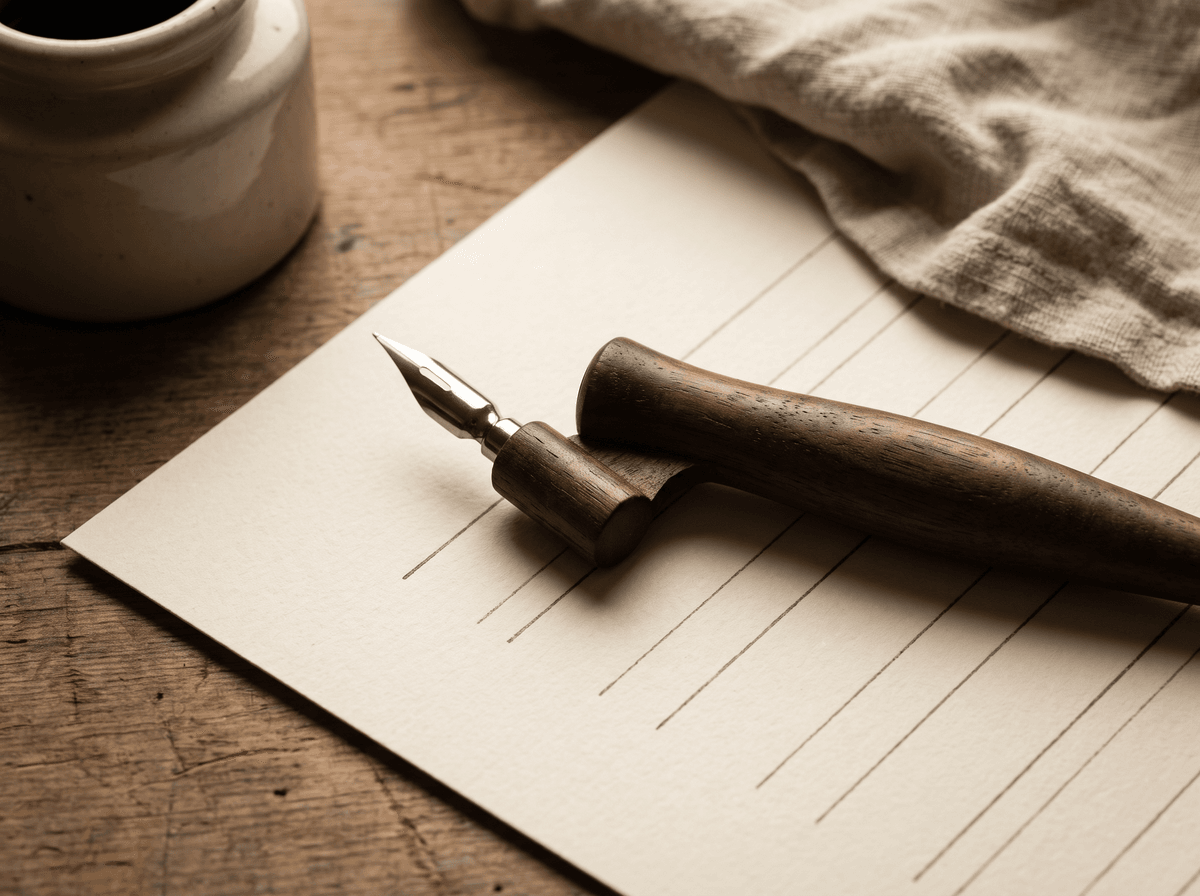
When to add it: as you go, or at the end?
The most important decision about accents isn't their shape but their timing. There are two methods, and both work if you apply them consistently.
- The accent follows its letter straight away
- The way most of us learned at school
- It lands more precisely above the letter
- It breaks the flow of the name
- Good for short names with few accents
- First the whole name, then every mark
- Like many people dot i's and cross t's
- The name can be written in one movement
- Accents drift more easily
- Good for long names with many accents
If you add them at the end, pick a fixed order, for example left to right, and always keep it. Some people add accents before the finish, others after it with a small swing back. For left-handers, adding accents at the end is especially comfortable because the hand doesn't drag through wet ink; our guide to signing left-handed goes into more detail.

Acute and double acute: á, é, í, ó, ú, ő, ű
The great advantage of acute accents is that they're strokes, not dots. A stroke can be drawn quickly with momentum, and it follows the slant of the signature well. A few tried-and-tested approaches:
- A short stroke, parallel to your slant. From lower left to upper right. If your signature leans right, let the accent lean the same amount, so it belongs to the line rather than looking foreign.
- Don't let it become a dot. In a hurry an acute easily shrinks to a dot, which reads more like an “i”. If you keep it, keep it a stroke.
- Double acute: two strokes or one. The two short parallel strokes of “ő” and “ű” are lovely and distinctive, but they slow you down. Many people use a single slightly longer slanted line, which is quick and still different from a plain acute.
- Merge it into the connection. If another letter follows the accented one, the accent can be an extension of the upward connecting stroke. It takes some practice, but the name stays one movement.
- Accented capitals. The accent on “É” or “Á” can sit far above the line. Our guide to the capital covers accented capitals in detail.
Take “Renée Gauthier”: the acute sits on the first of two “e”s, so a careless mark added at the end can easily land over the wrong one. Here a short stroke added as you go, straight after the “é”, keeps it clear. A Hungarian name like “Kőrösi Ágnes” works the other way round: the accent of the “Á” becomes part of the capital's entry stroke, and the marks on “ő” and “ö” go on at the end in one pass, a slanted line and a small dash.
Dots, háčeks and circumflexes: ö, ü, č, š, ž, â
Dots and small v-shaped marks behave differently from acutes. Dots are hard to keep consistent, while a háček almost writes itself with momentum. A few tips:
- Two strokes instead of two dots. In handwriting, many people write the dots of “ö” and “ü” as two very short slanted strokes or a single small horizontal dash. In a signature that's faster and doesn't vanish.
- The háček as a tick. The mark on Czech and Slovak “č”, “š”, “ž” and “ř” is a small “v”. One quick, tick-like movement, which suits a signature's flow.
- The circumflex as an upside-down tick. The Romanian “â” and “î” and the French “ê” and “ô” carry a little roof. Again one movement, just starting upwards.
- Size. Keep these marks smaller than the body height of your small letters. An oversized háček can look like a second capital.
A Czech example: “Šárka Dvořáková” has four different marks. Here the háček on the opening “Š” can become the capital's entry stroke, one sweeping tick that runs into the curve of the “S”. The háček on the “ř” and the acutes on the long “á”s go on at the end, in one pass.
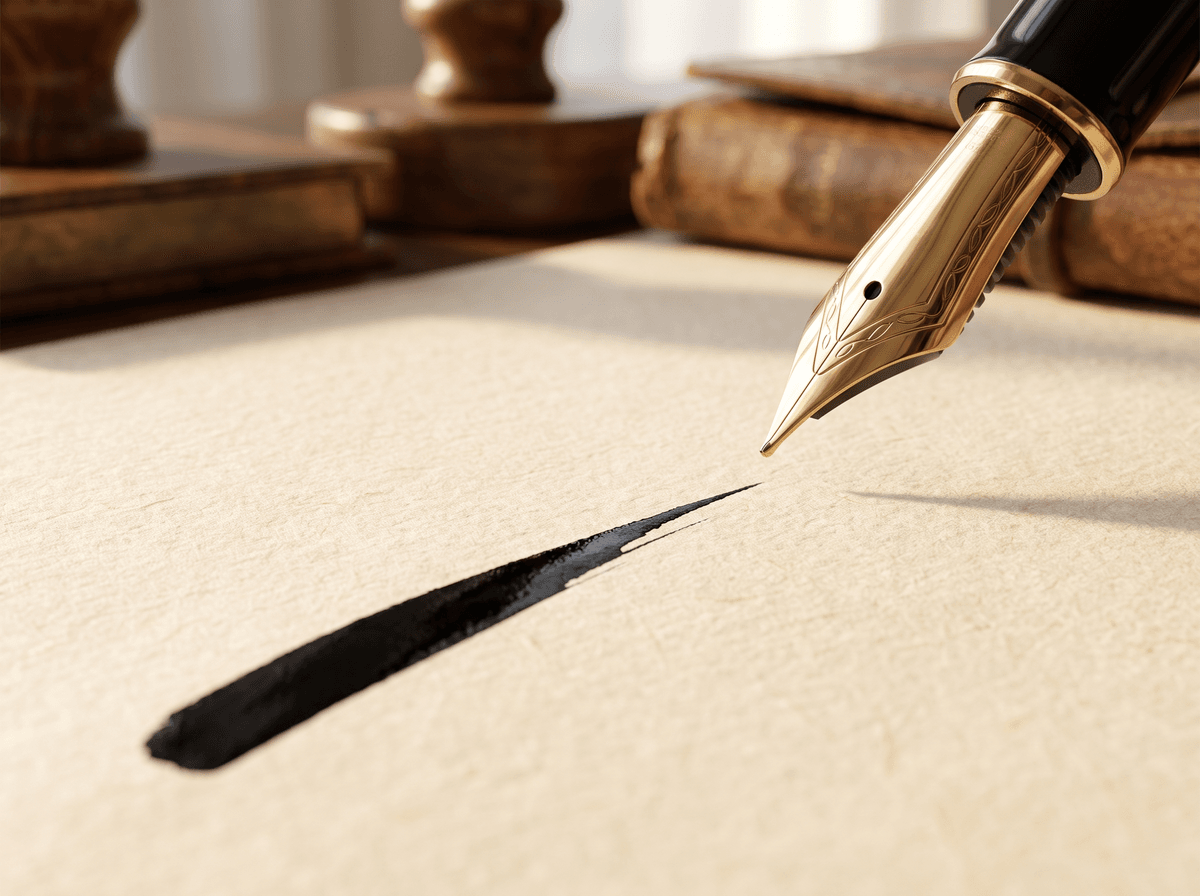
Marks below the letter: ç, ş, ș, ț, ą, ę
Marks below the letter are special because they cling to it and can often be written in the same movement. That's why they usually disturb a signature's flow less than marks above.
- Cedilla: ç, ş. The tail under French and Turkish “ç” and Turkish “ş”. It can continue from the bottom of the letter with a short hook before the pen moves on.
- Comma below: ș, ț. In Romanian, “ș” and “ț” carry a comma below, which is a different shape from the Turkish cedilla. In a signature it's a short separate stroke that many people leave until the end.
- Ogonek: ą, ę. The little hook on Polish nasal vowels. It curves down and to the right from the end of the letter and can lead neatly into the next one.
- Clashing with the finish. If your signature ends in an underline, marks below the letter can collide with it. Move the underline lower or choose a trailing finish instead. We cover the types of finish here.
Language by language: what works in practice
The list below sums up which marks appear in each language and the quick solution that works in most signatures. The example names are just illustrations.
- Hungarian: á, é, í, ó, ú, ö, ü, ő, ű. Acutes and double acutes, plus two dots. “ő” and “ű” can take a single slanted line. Example: “Kőrösi Ágnes”.
- Czech: á, é, í, ó, ú, ů, ý, č, ď, ě, ň, ř, š, ť, ž. Lots of háčeks and a small ring on the “ů”. The ring can be a tiny loop, each háček a tick. Example: “Jiří Novák”.
- Slovak: á, ä, č, ď, é, í, ĺ, ľ, ň, ó, ô, ŕ, š, ť, ú, ý, ž. The mark on “ľ”, “ď” and “ť” is a small apostrophe-like stroke beside the letter that can be pulled out of the ascender in one movement. Example: “Ľubica Hrušková”.
- Polish: ą, ć, ę, ł, ń, ó, ś, ź, ż. The bar through “ł” works like crossing a “t” and can go on at the end with the other marks. Make the dot on “ż” a tiny stroke. Example: “Łukasz Wójcik”.
- Romanian: ă, â, î, ș, ț. The breve on “ă” is a small u-shaped stroke; the commas under “ș” and “ț” can wait until the end. Example: “Ioana Pătrașcu”.
- Turkish: ç, ğ, ı, İ, ö, ş, ü. Mind the dot on the “i”: in Turkish, dotted and dotless “i” are two different letters. That matters less in a signature than in your printed name. Example: “Gökçe Yılmaz”.
- French: é, è, ê, ë, à, â, ç, î, ï, ô, ù, û. Many names have only one or two marks, and most can be handled with one short stroke. Example: “Hélène Lefèvre”.
On screens and in small spaces
Accents suffer most on screens. A terminal or a phone often records a quick touch as a dot or a smudge, and some systems even treat the signature as finished once you lift your finger. In a small box, an accent simply has nowhere to go.
- A stroke, not a tap. On a screen, draw a short slanted line rather than just touching the surface. A line survives; a tap often doesn't.
- In small spaces, merge or drop. If the box is barely bigger than your name, merging or dropping the accent is the cleanest solution.
- The same decision everywhere. If you drop it on paper, don't add it on screen, and vice versa. That way both versions look like the same signature.
We have separate guides to signing on screens and signing in very small spaces.
Official papers: signature versus printed name
Most confusion about accents comes from mixing up your signature and your printed name. They aren't the same thing, and different expectations apply to each.
- Keep the accents in your printed name. When a form asks for your name in capitals, write it correctly, with its accents. That's the version your name can be read from letter by letter.
- Your signature has more freedom. Your signature is your personal mark, not a copy of your name. If the accents are missing from it, that's not a problem in most places.
- When a system drops your accents. On forms abroad, booking systems and cards, your name often appears without accents. Your signature doesn't need to follow suit: it can stay the same as at home.
- Your specimen is the benchmark. Whatever you decide about accents, the specimen held by your bank and on your ID should be what you write day to day.
Practice: an accent is a movement too
The accent is the smallest part of your signature, so it's easy to forget while practising. Yet small elements are the first to drift when you rush. A few minutes of focused attention is enough.
- 1Decide the form. Keep, merge or drop? Write it on a sticky note so you don't change your mind halfway.
- 2Decide the timing. As you go or at the end, and if at the end, in what order.
- 3Practise it on its own. Write ten accents side by side at your chosen slant and size. If they all match, your hand has it.
- 4Put it back in the full signature. Ten times, one under another, at your normal pace. Check whether the accent lands in the same place each time.
- 5Try it on a screen. With a finger on a phone. If it vanishes or turns into a dot there, adjust the shape.
Our practice guide covers the general methods. Calligra designs your name complete with its accents, and the lesson shows stroke by stroke where and how each mark falls into place. Try it with your name.
The one sentence worth taking away
An accent in a signature isn't an obligation but a movement you can design: decide whether to keep, merge or drop it, use a short stroke instead of a dot, fix your timing, and write it the same way everywhere, on paper and on screen.
Questions
Can I leave the accents out of my signature?
Yes. A signature isn't the spelling of your name, so many people drop accents or merge them into another stroke. What matters is making the same choice every time. If an institution expects anything specific, they'll tell you.
Should I add accents straight away or at the end?
Both work. Adding them as you go is more precise; adding them all at the end is faster and lets you write the name in one movement. Pick one and stick with it.
How do I write two dots (ö, ü) quickly in a signature?
Many people turn the two dots into two very short strokes or a single small horizontal dash. It's faster than dots and doesn't disappear when you rush or sign on a screen.
What if my name is written without accents abroad?
Your printed name may appear without accents in some systems, but your signature doesn't have to change. Sign the same way you do at home so your signature stays consistent everywhere.
Why do accents disappear when I sign on a screen?
Many touchscreens don't record a quick tap, or record it only as a dot. Draw a short slanted line instead of tapping, or drop the accent consistently on paper too.
Try it with your own name
Read these too
Knowledge Style
Designing the capital: the face of your signature
The first letter carries the character, the rhythm and most of the recognisability. Proportion, entry strokes, loops, connections and simplification, step by step.
 Style
Underline, loop or tail? Finishing your signature
The last stroke sets the tone of a signature. Here are the most common finishes, what each one says, and how to pick the one that fits your name and the places you sign.
 Style
Middle names and nicknames: what goes into your signature?
Emily Rose, whom everyone calls Rosie. James Edward, who has gone by Ned since he was a baby. If you carry more than one name, your signature makes you choose: both, just one, an initial or the nickname. Here's when each one works.