Knowledge › Creative
Creative
Signature tattoos: a loved one's handwriting on your skin
A grandmother's signature from an old postcard, “love you” in your mum's hand, your own name the way you wrote it as a child. Here's where to find the sample, how to digitise it, what to discuss with your tattoo artist, and how to keep it beautiful for years.
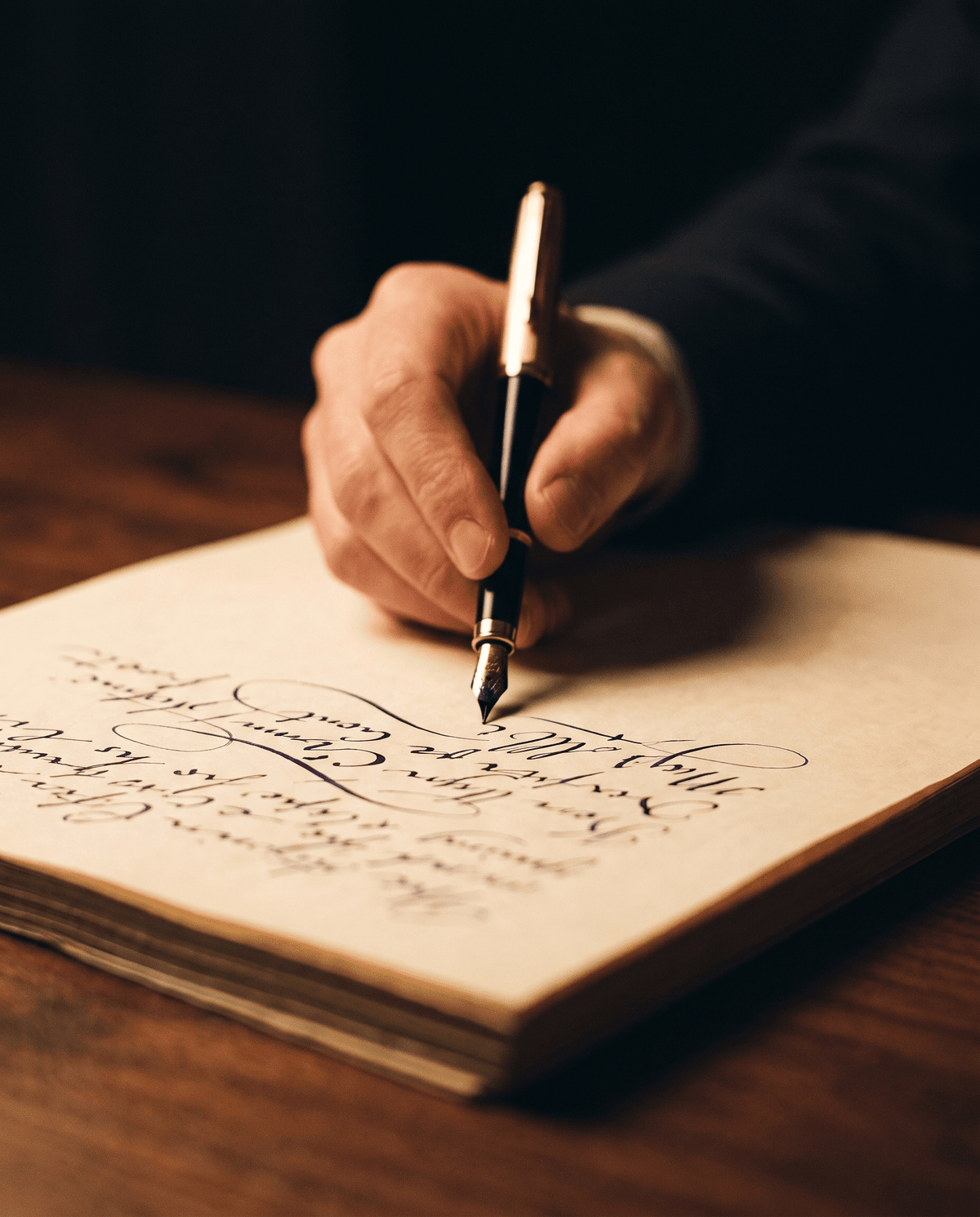
Few tattoos are as personal as handwriting. It isn't a design from a catalogue but a movement someone made with their own hand: its slant, its pace, its little imperfections. Many people wear the signature or a few words of a parent, grandparent or friend who has passed away; others choose their child's first signature, their partner's note or their own name. The secret of a good handwriting tattoo isn't decoration but faithfulness: the original movement should still be recognisable on the skin and stay readable for years. In this article we go through what to choose, where to find the sample and what's better left in the drawer, how to take a good photo or scan, what to discuss with your artist about line weight and size, and what to watch out for if you want your own signature tattooed. This isn't medical or dermatological advice: for anything to do with your skin, an experienced, licensed tattoo artist and, where needed, a doctor are the right people to ask.
Why handwriting?
A photo shows what someone looked like. Handwriting shows how their hand moved. That's why an old shopping list or a name at the bottom of a postcard can move you: that person was there and wrote this, exactly like this.
- Unique. No two handwritings are alike. Your tattoo won't look like anyone else's.
- A personal story. The sample has an origin: a letter, a birthday card, a recipe. That story stays part of the tattoo.
- Small, yet meaningful. A short signature or a single word fits on a wrist, an arm or over the heart, without needing a big area.
A signature, a name or a short phrase?
Before you look for the sample, decide what you'd like to wear. Each has a different feel, and different risks too.
- A first name or nickname in someone's hand.
- One or two words: “love you”, “always”, “Mum”.
- The sign-off of a card or letter instead of a full name.
- A child's first signature or drawn name.
- Someone's full official signature copied from a document.
- Your own signature, the one you use at the bank.
- Long sentences in tiny letters.
- Lots of decoration added afterwards.
Short, simple handwriting almost always ages better than long text. If a longer message is your favourite, consider picking out a single word or the name at the end.
Where to find the sample, and what to leave in the drawer
The best sample is something the person wrote naturally, without hurrying. Then the line is calm, the letters are in proportion, and it looks just like them.
- Letters and postcards. The name at the bottom or the closing line is often the finest handwriting, because the writer took care over it.
- Birthday cards and gift tags. Short, personal, and often carrying exactly the words you'd want to wear.
- Recipes, notebooks, book inscriptions. Everyday handwriting can make a beautiful sample too; just choose a clean, readable part.
- Avoid official documents. Rather than a signature copied from an ID card, a bank form or a contract, choose a personal source. Official specimen signatures are better kept out of public view.
- If the person is alive, ask. Use a parent's or partner's handwriting with their consent. Often they'll happily write you a fresh sample.

If you have several samples, don't settle for the first. Spread them out and see which is most like the person. A good artist can also help combine the most beautiful letters from two samples, but only in a way that keeps the character of the writing intact.
Digitising the sample, step by step
Your artist won't work from the old letter itself but from a good-quality image. The cleaner that image, the more accurate the tattoo. The original stays yours, safely kept.
- 1Scan it if you can. A simple flatbed scanner at 600 dpi or more is best. Keep the paper completely flat; don't bend it under the lid.
- 2If you photograph it, use daylight. Next to a window, without direct sun or flash, from straight above. A photo taken at an angle distorts the proportions of the letters.
- 3Take several shots. In slightly different light and from different distances. You can choose later, and your artist will appreciate the options.
- 4Don't over-“beautify” it. You can brighten the background and remove stains, but don't redraw the strokes themselves. The small tremors and irregularities are the soul of handwriting.
- 5Put the original away. Don't take it to the studio or stick it up anywhere. An envelope or a folder protects it.

Scanning and cleaning the background is the same job as preparing a signature for a PDF. If you'd like more detail, the article on signing PDFs and e-documents also covers making a clean signature image.
What to discuss with your tattoo artist
Handwriting tattoos are a genre of their own. Thin, flowing lines, delicate exits and small letters ask for something different from a classic design. Look for an artist whose portfolio includes script or fine-line work, including older pieces that have already aged.
- Line weight. Very thin lines can blur and spread over the years. Ask what thickness will last on your skin and in your chosen spot.
- Size. If handwriting is shrunk too far, the insides of the letters can run together. Your artist can tell you the smallest size at which it stays readable.
- Faithfulness to the original. Agree in advance how much they may correct. Many artists would smooth the line, yet handwriting is real precisely because of its small irregularities.
- The stencil test. With the stencil in place you can still decide: look in the mirror, while moving, from several angles.
- Aftercare. Ask for your artist's aftercare instructions in writing and follow them. For questions about healing, your artist or a doctor is the right person.
Where should it go, and how big?
Placement isn't only an aesthetic question. Where skin moves a lot, rubs or often catches the sun, fine lines can change faster. Your artist is the best person to advise you, but a few points are worth thinking through yourself first.
- Visible or hidden? The wrist and inner forearm are always in front of you; the shoulder blade or ribs are more just for you. Decide who the tattoo is for.
- Reading direction. If it's on your arm, decide whether you want to read it yourself or have the person facing you read it. That determines how the design is oriented.
- Proportion to the body part. A long signature looks good along the forearm or collarbone; a short name on the wrist or the side of a finger.
- Leave room. If you might add something later, such as a date or a second name, discuss it in advance so there's space.
A handwriting tattoo has worked if, years later, you still see them in it, not the artist's hand.
If you want your own signature tattooed
Many people would like to wear their own name: their childhood signature, an autograph or an important new signature. It's a lovely idea, but one thing is worth keeping in mind: whatever you wear on your skin, anyone can photograph.
- Not your official signature. The one you use at the bank and on your documents shouldn't end up in public. So for your own tattoo, choose a different form.
- An autograph version is better. A slightly different, showier form that's yours but isn't your bank specimen. We wrote about this in the article on official signatures and autographs.
- Or an old form. Your childhood or teenage signature is a keepsake too, and it isn't the one you use officially today.
What's worth showing of your signature and what isn't is covered in detail in the article on protecting your signature online. And if you'd like a new form of your own before the tattoo, the style quiz suggests a style that suits you from eight questions.
If it's the handwriting of someone you've lost
Memorial tattoos mean a great deal, and that's exactly why they're worth not rushing. There's no deadline: the sample will still be on the letter even if you decide a year from now.
- 1Give yourself time. Choose the sample, then put it aside for a few weeks. If you still feel the same afterwards, it's a good decision.
- 2Talk to your family. A sibling or parent may have a letter too, and someone may want a shared tattoo from the same sample.
- 3Keep the original safe. After scanning, put it somewhere secure. You can make copies for the family too.
Nora kept her grandmother's postcards in a box. Every card ended the same way: “Love, Nan”. She didn't choose the full signature, just the word “Nan”, with her grandmother's characteristic, slightly shaky “N”. One afternoon she photographed the nicest card in daylight; with her artist she agreed not to smooth out the tremor and to choose a slightly thicker line so it would stay readable for years. It went on the inside of her wrist, oriented so she could read it herself. The postcard went back in the box.

Common mistakes, and how to avoid them
Most disappointments come from a handful of recurring mistakes that a little preparation can prevent.
- Too small. The letters run together after a few years. Solution: ask your artist about the smallest size that stays readable.
- Too thin a line. The delicate exits blur. Solution: agree the line weight based on the placement and your skin.
- An over-polished sample. The handwriting turns into a font. Solution: clean the background, keep the strokes.
- The wrong source. A signature copied from an official document. Solution: choose a letter, card or note.
- Your own bank signature. Anyone can photograph it. Solution: an autograph version or an old form.
- Rushing. You decide in the first wave of emotion. Solution: put the sample aside for a few weeks, and only then book.
The one sentence worth taking away
With a handwriting tattoo, faithfulness is everything: choose a personal sample written calmly, digitise it without beautifying, agree line weight and size with your artist, and wear a different form rather than your own official signature.
Questions
What resolution should I scan handwriting at for a tattoo?
At least 600 dpi, with the paper completely flat. If you photograph it, use daylight, no flash, and shoot from straight above. It helps to give your artist several images to choose from.
Will a fine-line handwriting tattoo blur over time?
Very thin lines and small letters are more prone to blurring and spreading over the years, but it depends on many things: your skin, the placement, the technique and aftercare. Your artist can give you specific advice for your case.
Can I get my own signature tattooed?
Yes, but rather than the official signature you use at the bank and on documents, choose a different form, such as an autograph version or an old childhood signature, because anyone can photograph a tattoo.
What if the handwriting is shaky or uneven?
That's often exactly what gives it soul, so don't smooth it out. Discuss with your artist how to carry it over faithfully and, if needed, make it lasting with a slightly thicker line.
Do I need permission to use someone else's handwriting?
If the person is alive, always ask first; it's a matter of basic respect. For the handwriting of someone you've lost, it's worth talking to the family too, especially if the sample matters to others.
Try it with your own name

Read these too
Knowledge Creative
Wedding invitations and thank-you cards: how to sign them as a couple
Who signs, in what order, with your old name or your new one, first names or full names? Here are the wordings that work, how to make two signatures look right side by side, and how to keep the fiftieth card as neat as the first.
 Basics
What makes a signature look professional?
It isn't the number of flourishes. Flow, a strong capital, a consistent slant, good proportions and a clean finish make a signature confident and repeatable.
 Basics
How legible should your signature be?
Not every letter needs to be readable, but pure chaos isn't the answer either. Here's how to find the balance between legibility and personality.